

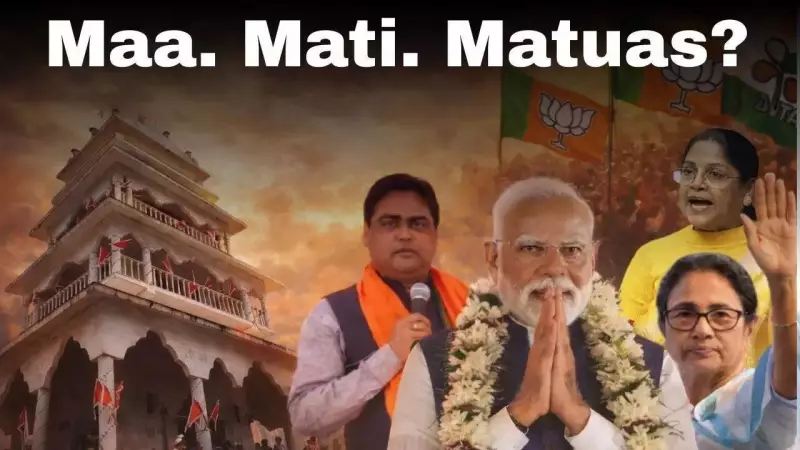
When inclement weather forced Prime Minister Narendra Modi to cancel a scheduled public meeting in West Bengal's Ranaghat on December 20, he turned the setback into a strategic political communication. He issued a targeted message specifically addressing the Matua and Namasudra community, acknowledging their long-standing struggle for a secure place in India. This direct outreach from a sitting Prime Minister to a caste-based religious group was far from routine; it was a calculated move underscoring a significant political reality. The Matua-Namasudra community has moved from the margins to the center of Bengal's political arena.
The Historical Roots of a Political Powerhouse
The significance of PM Modi's gesture cannot be understood without delving into the community's layered history of caste oppression, religious reform, and displacement. The Namasudras are indigenous to eastern Bengal, now Bangladesh, where for centuries they endured severe caste discrimination, historically labeled as "Chandal." In the late 19th century, the Matua socio-religious movement, founded by Harichand Thakur, offered a radical break from Brahminical Hinduism, preaching equality and self-respect.
This assertion was crucial at a time when conversion to Islam appeared as a potential escape from humiliation for some oppressed castes. Harichand Thakur's teachings provided an alternative space within a syncretic Dharmic framework, helping retain many within the Hindu fold. His son, Guruchand Thakur, further institutionalized education and political awareness, famously calling the Namasudras a "Bir Jaati" or brave race.

The Partition of 1947 began a prolonged period of displacement for the community. Waves of Namasudras migrated to India over decades, fleeing communal violence and instability in East Pakistan (later Bangladesh). They settled in refugee colonies in West Bengal, notably in North 24 Parganas, where Thakurnagar emerged as the spiritual and organizational Mecca of the Matua movement.
From Social Movement to Electoral Clout
Today, the Matua-Namasudra community is among the largest Scheduled Caste groups in West Bengal, estimated to form 17-18% of the state's population. Their political influence stretches across key districts like North and South 24 Parganas, Nadia, Howrah, and Cooch Behar. Electoral analysts note that Matua voters can sway outcomes in 60-65 assembly seats and at least six parliamentary constituencies, giving them substantial bargaining power in a politically competitive state.
For decades, this power was aligned with the Left Front and later the Trinamool Congress (TMC). The Bharatiya Janata Party's (BJP) rise in Bengal post-2014 changed this dynamic. The party's emphasis on identity and citizenship resonated deeply. The Citizenship Amendment Act (CAA), which promises citizenship to non-Muslim refugees from Bangladesh, Pakistan, and Afghanistan who entered India before 2014, directly addresses the Matua community's existential anxieties stemming from Partition and persecution.
This political shift was evident in the 2019 Lok Sabha elections when the BJP's seat count in Bengal jumped from 2 to 18, with decisive swings in Matua-heavy constituencies like Bongaon and Ranaghat. The symbolic heart of the community, the Thakur family of Thakurnagar, reflects this political cross-current. While Boroma (Binapani Devi) was a revered matriarch, her grandson Shantanu Thakur is a BJP MP, and her daughter-in-law, Mamata Bala Thakur, has been associated with the TMC.
The Citizenship Promise and Contemporary Anxieties
PM Modi's recent message, invoking the CAA and framing dignity as a political right, comes at a sensitive time. It can be seen as an attempt to reassure the community amid concerns over the Silent Invisible Rigging (SIR) process and the revision of electoral rolls. Junior Union Minister Shantanu Thakur's statement about potential voter deletions within the community has caused unease.

The TMC has seized on this, accusing the BJP of betrayal. The ruling party in Bengal claims the BJP used the promise of citizenship to secure votes only to later support processes that could disenfranchise Matuas. In this charged atmosphere, PM Modi's assurance seeks to separate administrative actions from the broader promise of belonging offered by the CAA.
As West Bengal looks ahead to the 2026 state elections, the Matua-Namasudra community's choices will be pivotal. According to Deep Halder, author of "Bengal 2021: An Election Diary," the community's decisions are influenced by more than just domestic politics. Developments in Bangladesh, including incidents of violence against minorities, rekindle memories of why many left. This, coupled with a strong, generation-spanning awareness of their unique history and identity, informs their political calculus.
For the Matua-Namasudras, politics is not merely about electoral arithmetic. It is deeply intertwined with a collective memory of humiliation, displacement, and a hard-fought struggle for dignity and recognition. Their political loyalty is not permanently vested in any single party but is pragmatic, shaped by lived experience. As Bengal gears up for another intense electoral cycle, the community stands as a powerful reminder that voting behavior is often a direct negotiation with history, identity, and the unfulfilled promises of the state.





