

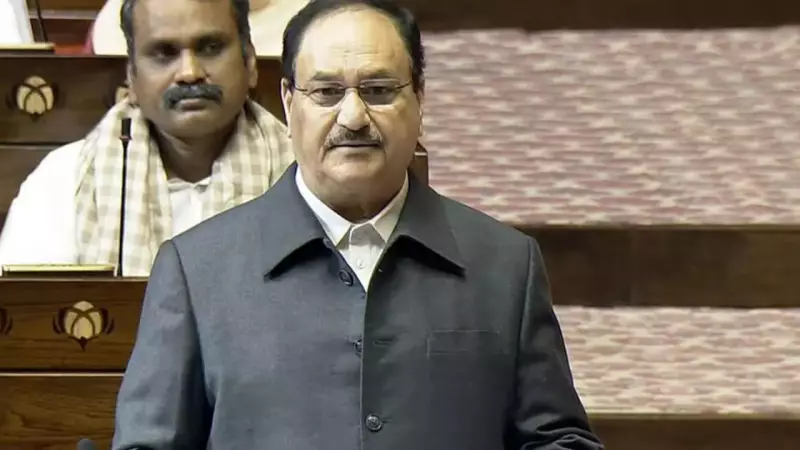
Leader of the House in Rajya Sabha, J P Nadda, made a strong appeal to opposition parties on Tuesday, urging them to unite in support of a Special Intensive Revision (SIR) of the electoral rolls. This call came during a parliamentary debate focused on electoral reforms, where Nadda presented data highlighting a dramatic surge in the number of voters in West Bengal over the past two decades.
Staggering Rise in West Bengal's Electorate
Drawing from Election Commission of India (ECI) data, Nadda pointed out that West Bengal's total electorate has ballooned from 4.8 crore to 7.6 crore since the last comprehensive Special Intensive Revision was conducted in 2002. He emphasized that this represents a massive and concerning increase that warrants scrutiny.
Delving deeper, the BJP leader shared district-wise figures for nine West Bengal districts that share a border with Bangladesh. He revealed that the minimum increase in the voter list in these districts since 2002 was 70%, with the maximum crossing an astonishing 100%. The most significant spikes were recorded in Uttar Dinajpur (105.5%), Malda (94.8%), Murshidabad (87.6%), 24 Parganas (83.5%), and Jalpaiguri (82.3%).

The Question of Illegal Immigrants and National Mandate
Nadda directly linked this unprecedented growth to demographic changes, stating, "In West Bengal, the total increase in (numbers of) a particular community is 7.5%." He then posed a pointed question to the House, asking why the Election Commission should not fulfill its mandate to detect illegal immigrants who might be responsible for this surge.
"Should they not be detected, deleted, and deported?" he questioned, echoing Home Minister Amit Shah's stated policy. Nadda concluded his arguments by framing the issue as a matter of national integrity, asserting that the discussion must transcend political considerations. "We must ponder on whether the country should be run as per the mandate from illegal immigrants or as per the mandate of its citizens?" He sought cross-party cooperation in the EC's SIR drive to identify and remove non-citizens from the voter lists.
Opposition's Counter and Political Sparring
The debate saw sharp reactions from the opposition benches. While Nadda mocked the opposition for previously criticising the EC as 'vote chor' (vote thieves)—citing Rahul Gandhi's 16-day 'Vote Adhikar Yatra' in Bihar that failed to translate into electoral success for Congress—other parties clarified their stance.
DMK's Tiruchi Siva intervened during Nadda's speech to clarify that the opposition was not inherently against the SIR process, but objected to the manner in which it was being implemented.
Earlier, Trinamool Congress MP Derek O'Brien launched a strong counter-offensive, accusing the government of using the SIR as a tool to "divide, distract and deflect" public attention from its governance failures. He retorted that the responsibility for securing borders and preventing infiltration lies with the Union Home Minister, not the state Chief Minister.
The debate, which began on Monday, also featured Congress leader Randeep Surjewala warning that any dilution of voting rights or institutional independence, particularly of the ECI, would strike at the heart of constitutional democracy and hollow out the republic.






