

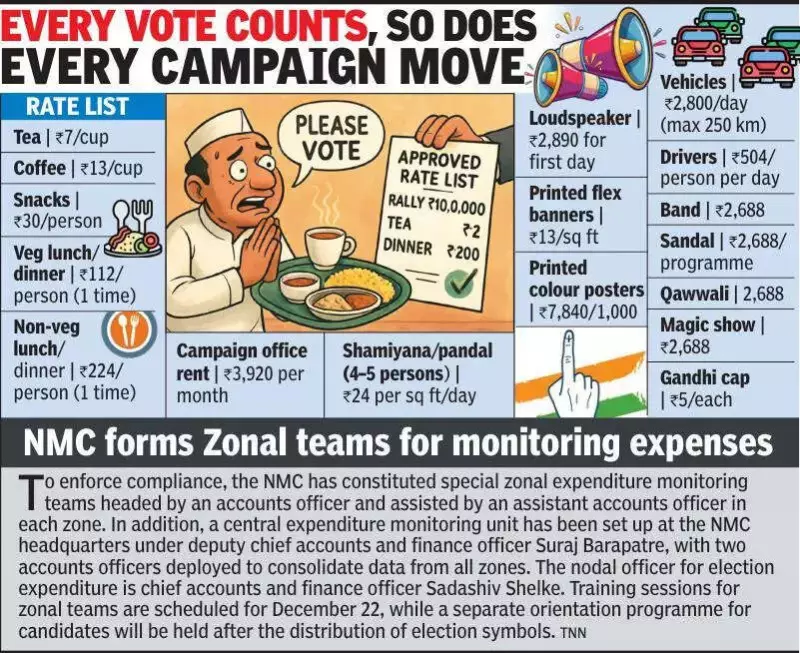
In an unprecedented move to bring financial discipline to the upcoming civic polls, the Nagpur Municipal Corporation (NMC) has assigned a fixed price to every cup of tea, meal, and campaign activity. With the per-candidate spending cap dramatically increased, election authorities are leaving no room for unaccounted expenses in the run-up to the January 15 elections.
Strict Rate Card for Every Campaign Activity
The municipal commissioner and election officer, Abhijeet Chaudhari, has finalised a comprehensive Schedule of Rates that will form the backbone of the expenditure monitoring framework. This detailed list, spanning several pages, is a direct response to the State Election Commission's decision to raise the spending limit from Rs4 lakh in the 2017 civic polls to Rs15 lakh this year — a staggering 275% increase.
Officials acknowledge that while the hike accounts for inflation and rising logistical costs, it also raises the risk of money power influencing the electoral contest. The new rate card is a conscious effort to plug long-standing loopholes where informal campaigning and cash-heavy operations were common in ward-level battles.

From Chai to Campaign Offices: A Detailed Breakdown
The new regime meticulously costs the most frequent yet often understated election expenses: food and refreshments. A cup of tea served at any campaign office or meeting will now be charged at Rs7, while coffee is priced at Rs13. A glass of lassi or a cold drink bottle carries a Rs22 tag, and snacks are assessed at Rs30 per person.
For meals, the distinction is clear: Rs112 per person for a vegetarian lunch or dinner and Rs224 for a non-vegetarian meal per sitting. Election officials stated these benchmarks will be applied uniformly during audits, irrespective of party affiliation. Hosting frequent meals beyond declared numbers can quickly inflate a candidate's expenditure statement, pushing them dangerously close to the Rs15 lakh ceiling.
Campaign infrastructure is another major cost centre under the scanner. Hiring a loudspeaker system will cost Rs2,890 for the first day, and generators (3-10 KVA capacity) over Rs5,000 daily. Even modest ward meetings will be assessed using prescribed rates for pandals, podiums, chairs, lighting, and carpets.
Enhanced Monitoring and Enforcement Mechanism
To enforce compliance, the NMC has constituted special zonal expenditure monitoring teams. Each team, headed by an accounts officer and assisted by an assistant accounts officer, will collect and verify daily expenditure statements from candidates. A central expenditure monitoring unit has also been set up at the NMC headquarters under deputy chief accounts and finance officer Suraj Barapatre.
The nodal officer for election expenditure is chief accounts and finance officer Sadashiv Shelke. Training sessions for zonal teams are scheduled for December 22, and an orientation programme for candidates will follow the distribution of election symbols.
Publicity expenses, crucial in modern campaigns, are tightly regulated. Printing posters, pamphlets, and voter cards have fixed per-thousand rates, while flex banners are charged per square foot. Video recording of events for social media will add over Rs1,200 daily to a candidate's account in urban areas.
Even running a campaign office is clearly defined: rent for a standard 10x10 ward office is fixed at Rs3,920 per month. Honorarium for workers is Rs392 per person per day, and drivers accompanying candidates will attract a daily expenditure of Rs504. Candidates must also maintain a separate bank account exclusively for election-related transactions.
With allegations of unchecked spending marring previous polls, officials believe that putting a price tag on every activity is the most effective way to ensure the January 15 contest is fought on a platform of transparency, matching political ambition with financial accountability.






