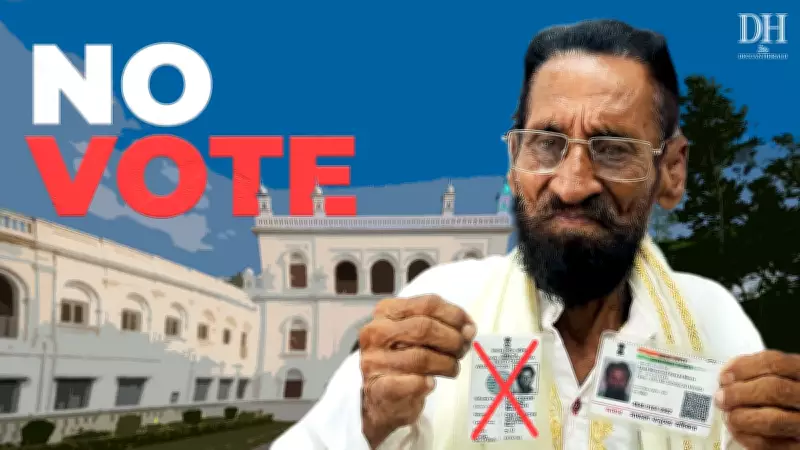
In a significant development ahead of the 2026 West Bengal Assembly elections, the Nawab of Murshidabad, Syed Mohammed Abbas Ali Mirza, has been stripped of his right to vote. The decision, confirmed by the Election Commission of India, has sparked debate about the electoral status of historical royal figures in the state.
Background of the Nawab's Disenfranchisement
The Nawab of Murshidabad is a titular head of the former princely state of Murshidabad. While the position holds ceremonial and cultural significance, it does not confer any political authority. However, the Nawab has been an active participant in local politics, often endorsing candidates and influencing voters in the region. The Election Commission's move to remove his name from the electoral rolls has come as a surprise to many.
Reasons for the Removal
According to official sources, the Nawab's name was removed from the voter list due to discrepancies in his residential address. The Election Commission stated that he failed to provide sufficient proof of residence in the constituency where he was registered. This is not the first time the Nawab has faced such issues; similar complaints were raised during the 2021 assembly elections, but no action was taken at that time.

Political Implications
The disenfranchisement of the Nawab could have far-reaching implications for the upcoming elections. The Nawab has traditionally been a supporter of the Indian National Congress, and his absence from the electoral process might affect the party's prospects in the Murshidabad region. Political analysts suggest that this move could be part of a larger strategy by the ruling party to neutralize influential figures who are not aligned with them.
Reactions from the Nawab and His Supporters
The Nawab has expressed disappointment over the decision, stating that it is a violation of his fundamental rights. His supporters have called for a review of the Election Commission's decision, arguing that the Nawab has deep roots in the region and his contributions to the community are well-known. However, legal experts point out that the Election Commission's decision is based on technical grounds and is unlikely to be overturned.
Historical Context
The Nawab of Murshidabad is a descendant of the Nawabs of Bengal, who ruled the region before the British East India Company took over. While the title is now ceremonial, it still commands respect among certain sections of the population. The current Nawab has been involved in various social and cultural activities, which has helped him maintain a degree of influence.
What This Means for the 2026 Elections
With the Nawab losing his voting rights, the political landscape in Murshidabad could see a shift. Other political parties, including the Trinamool Congress and the Bharatiya Janata Party, may try to capitalize on this development to gain support in the region. The Congress party, on the other hand, will need to find alternative ways to mobilize voters without the Nawab's active participation.
The Election Commission has clarified that the Nawab can re-register as a voter if he provides the necessary documentation. However, given the ongoing legal and political complexities, it remains to be seen whether he will be able to regain his voting rights before the 2026 elections.