

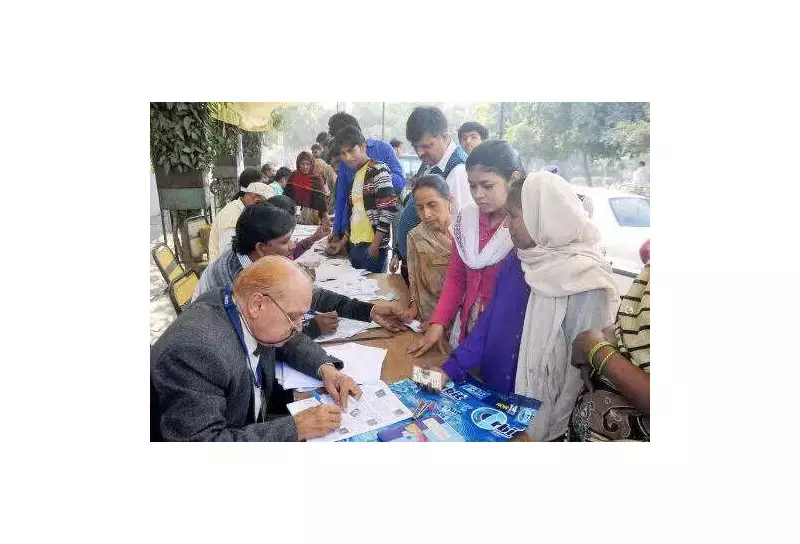
In a reversal of the usual urban migration narrative, a significant number of residents in the National Capital Region (NCR) are making journeys back to their ancestral villages. Their purpose is not just familial visits, but to actively ensure their voter registrations remain tied to their rural addresses. This trend is prominently visible during the ongoing Special Intensive Revision (SIR) of electoral rolls, where many choose verification over updating their city address.
Beyond the Ballot: Voter ID as a Lifeline to Ancestral Roots
The decision to retain a village vote is seldom about electoral convenience. For countless families, the Electors Photo Identity Card (EPIC) serves a critical administrative function that transcends its primary purpose. In Uttar Pradesh, numerous government welfare schemes, particularly those targeting rural populations, accept the voter ID as valid proof of identity and residence. It is often linked to crucial documents like land records, ration cards, and Direct Benefit Transfer (DBT) accounts.
Vishal Kumar, who lives in Greater Noida's Sector Delta 2 but votes from Atta Gujaran village, encapsulates this practical concern. He travelled back for SIR verification, stating, "I want at least one official document that proves my link to the village. When it comes to ancestral property or inheritance disputes, village records carry weight." This fear of complicating already-linked records or losing access to benefits is a powerful deterrent against changing the address on the EPIC.

The Emotional and Political Pull of the Gram Panchayat
The connection is not merely transactional; it is deeply emotional and political. For many, the village represents a permanent home and a cultural anchor. R.K. Singh, a Vasundhara resident for two decades, continues to vote in Muzaffarnagar. "We vote in our gram panchayat elections. It is a tradition," he says, noting that while his sons shifted their votes, his village remains his permanent address.
Praveen Bhartiya from Noida's Sector 150 travelled to Moondhi Bakapur village in Bulandshahr for the SIR process. He highlights the communal ease and political necessity: "If we stop voting there, we lose our voice with the pradhan, who listens mainly to voters." He also found the process simpler in the village setting, with the local headman facilitating a gathering at a chaupal.
Uncertain Urban Life vs. Permanent Village Address
For migrants living in rented accommodations across Noida and Ghaziabad, the impermanence of city life reinforces their choice. An anonymous resident of Shipra Sun City, Indirapuram, originally from Firozabad, explained his rationale. Having moved homes twice in three years due to landlord issues, he said, "This address is never permanent, but my village address will always be. It makes more sense to keep that on my voter ID."
Vikas Kashyap, an electrician in Noida's Sector 142 for a decade, filed his SIR form from his Ghazipur village. With his parents still there and plans to eventually return, his worry is futuristic: "When my parents won't be alive, how will I prove my residence and avail welfare schemes? If I am marked as shifted now and my name is removed, it might be very difficult to get it restored later."
The ongoing electoral revision has thus unveiled a complex tapestry of motivations where the voter ID becomes a symbolic and practical tether to one's origins. It underscores a reality where legal documentation, social security, and emotional belonging are intricately woven into a single card, making the simple act of updating an address a potentially high-stakes decision for India's urban migrants.






