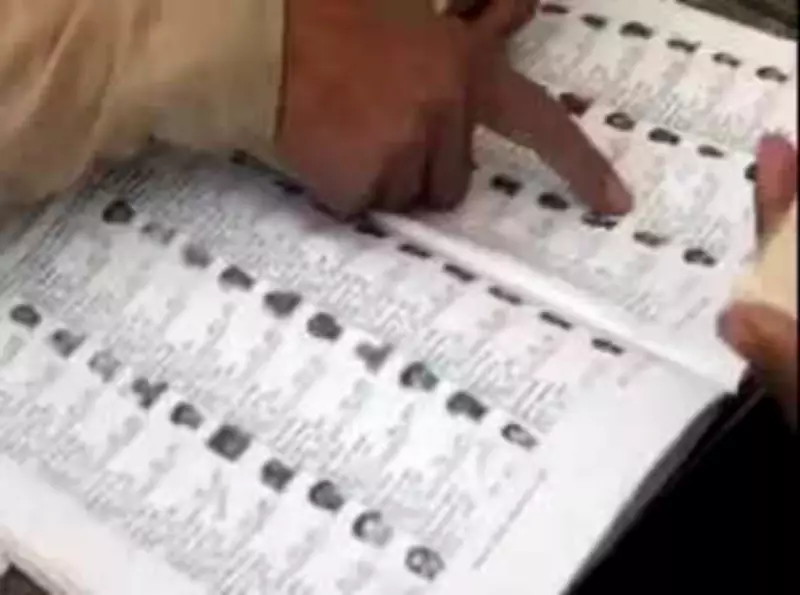
Chandigarh: At least one or more logical discrepancies have been observed in nearly one out of five voters in Punjab during the pre-special intensive revision (SIR) exercise, according to official data. The data accessed by the TOI revealed that among more than 1.80 crore voters mapped so far in the state in the ongoing pre-SIR exercise, there were over 37.29 lakh electors with anomalies, which translates into 20.66% of voters with discrepancies – comparing 2025 electoral rolls in Punjab with the legacy rolls.
While Punjab's legacy electoral rolls date back to 2003, the reference year varies across states, with some using 2002 or 2004 rolls depending on when the last intensive revision was carried out by the Election Commission. During the pre-SIR exercise, Punjab's 2025 electoral rolls were compared not only with the state's own legacy rolls dating back to 2003, but also with legacy databases of other states wherever voters were linked to another state through migration or past enrolment records.
Nature of Discrepancies
According to an official in the chief electoral office (CEO), Punjab, the majority of the logical discrepancies flagged in the state relate to atypical age gaps in family linkages, including less than a 15-year gap between a parent and child and less than a 40-year difference between a grandparent and grandchild, besides spelling and transliteration inconsistencies in voter details. With 45.03%, voters in the Amritsar Central constituency have the maximum anomalies, followed by 41.43% in Amritsar North and 39.94% in Amritsar South. The least, 10.43% anomalies were recorded in the Raikot constituency, followed by 10.94% in Dakha and 12.3% in Bassi Pathana.

Official Response
Anindita Mitra, chief electoral officer (CEO), Punjab, said, "Our election machinery through our booth-level officers will verify all the flagged discrepancies and resolve the same expeditiously." Notably, the SIR of electoral rolls in Punjab is set to kick off on June 15 with the training of the election officials and printing of the enumeration forms, which are to be filled by the electors. Beginning June 25, the booth-level officers (BLOs) will start house-to-house visits to get the forms filled. The final electoral rolls under the SIR will be published on October 1, months ahead of the state assembly elections, which are due in the first quarter of 2027.
Mapping Progress
In the pre-SIR exercise, of more than 2.14 crore voters, Punjab has already mapped over 1.8 crore voters, translating into mapping of over 84% of the total voters. According to Mitra, Punjab targets to map at least 90% of the total voters before the BLOs start house-to-house visits on June 25. As per the pre-SIR mapping data in Punjab till April 28, over 40% of the voters were mapped through progeny mapping, meaning that nearly four out of every 10 voters in the 2025 electoral rolls in the state were linked by establishing family relationships as children or grandchildren of electors figuring in the legacy rolls. The progeny-mapped electors included the younger or newly enrolled electors who did not figure in the legacy rolls.
SIR Timeline in Punjab
- June 15 to June 24: Preparation, training, and printing of enumeration and other forms
- June 25 to July 24: Booth-level officers will go house to house to distribute enumeration forms
- July 31: Based on the enumeration forms received, draft electoral rolls will be published
- July 31 to Aug 30: Filing of claims and objections
- July 31 to Sept 28: Notice/disposal of claims and objection phase
- Oct 1: Publication of final electoral rolls
Redressal Mechanism
During the notice period, the Electoral Registration Officers (EROs) will issue notices to all individuals whose records could not be linked when comparing the 2003 and 2025 electoral rolls, or if any serious discrepancy exists. Seven days will be given for a hearing after serving such notices. After that, the ERO will issue a 'Speaking' order. If someone is not satisfied with the order, they can appeal to the district election officer (DEO) and, if still not satisfied, to the CEO.

District-wise Electors with Anomalies
- Mohali: 1,49,641 (26.59%)
- Ludhiana: 4,16,220 (20.92%)
- Jalandhar: 2,89,255 (21.74%)
- Kapurthala: 98,118 (19.43%)
- Patiala: 2,78,212 (22.23%)
- Pathankot: 87,810 (20.74%)
- Faridkot: 77,632 (18.69%)
- Ropar: 88,384 (18.64%)
- Gurdaspur: 2,25,055 (20.47%)
- Ferozepur: 1,25,784 (20.35%)
- Fazilka: 1,43,726 (21.33%)
- Sangrur: 1,48,109 (18.56%)
- Fatehgarh Sahib: 61,990 (15.64%)
- Bathinda: 1,68,893 (18.42%)
- Moga: 1,07,746 (16.22%)
- Hoshiarpur: 1,74,650 (15.64%)
- Amritsar: 5,24,889 (30.16%)
- Nawanshahr: 82,979 (19.41%)
- Malerkotla: 63,642 (21.97%)
- Barnala: 71,127 (16.04%)
- Muktsar: 1,09,017 (17.05%)
- Tarn Taran: 1,46,012 (20.25%)
- Mansa: 90,599 (16.30%)
- State total: 37,29,490 (20.66%)