

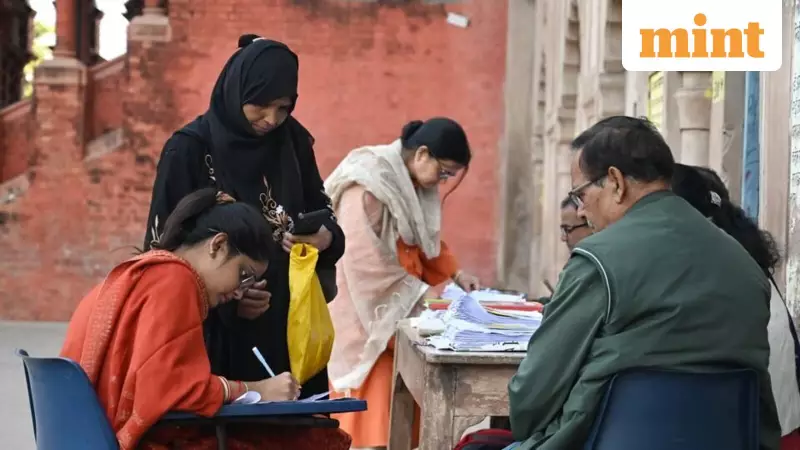
In a significant intervention, the Supreme Court of India on Thursday issued a set of directives to state governments to alleviate the immense work pressure on Booth Level Officers (BLOs) engaged in the Special Intensive Revision (SIR) of electoral rolls. This move comes in response to alarming reports, including instances of BLOs dying by suicide, allegedly due to the intense strain of the exercise.
What Prompted the Supreme Court's Intervention?
The apex court's bench, led by Chief Justice of India Surya Kant and including Justice Joymalya Bagchi, was hearing an application filed by the Tamilaga Vettri Kazhagam (TVK). The party alleged that the Election Commission of India (ECI) was imposing coercive measures on already overburdened BLOs responsible for the SIR.
Representing TVK, Senior Advocate Gopal Sankaranarayanan presented grave concerns to the court. He stated that they had details of 35 to 40 BLOs who had committed suicide, many of whom were Anganwadi workers and teachers. He highlighted that Section 32 of the Representation of the People Act (ROPA) notices were being sent, threatening imprisonment for up to two years for missing deadlines. Furthermore, he cited that about 50 FIRs had been filed against BLOs in Uttar Pradesh.

"There was a boy who wanted to attend his wedding. He was denied and he committed suicide. This is a human story," Sankaranarayanan told the Bench, as reported. The Election Commission, represented by Senior Advocate Maninder Singh, opposed the plea, calling it "absolutely unfair."
Supreme Court's Observations and Key Directives
The court acknowledged the seriousness of the issues raised, noting that TVK was espousing the cause of employees unable to perform duties due to health, family, or other personal circumstances. It also recorded that criminal action was being initiated against some reluctant employees.
Emphasizing that while the SIR is a statutory duty of the ECI, the responsibility to mitigate hardships lies with state governments, the Bench issued three clear directions:
- Deploy additional staff to reduce the working hours of those engaged in the SIR exercise.
- Consider exemption requests on a case-by-case basis, especially for health or personal reasons, and ensure prompt replacements.
- Permit those seeking other relief to approach the Court directly if their concerns are not addressed.
The court also reaffirmed that states must provide extra workforce wherever needed to complete the revision both efficiently and humanely.
Broader Context of the SIR Challenge
This hearing is part of a larger set of petitions challenging the execution of the SIR in several states, including Tamil Nadu, West Bengal, Uttar Pradesh, and Kerala. Petitioners have argued that a lack of adequate manpower and excessive administrative pressure has created unsustainable working conditions for BLOs.
These officers are often teachers, Anganwadi workers, or low-level staff with limited institutional support. The sharp rise in distress signals, including the suicides cited, forced judicial scrutiny of the ECI's methods and the states' resource allocation for this critical democratic exercise.






