

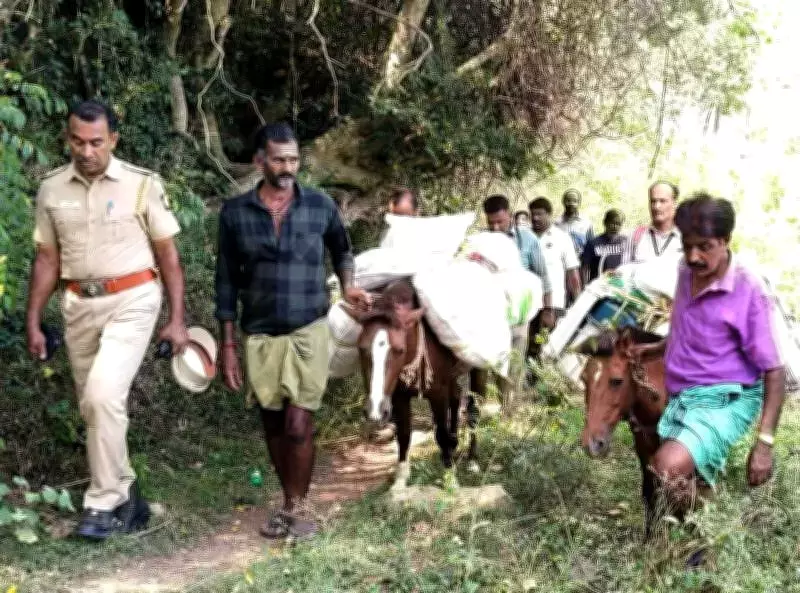
Election Officials in Tamil Nadu Deploy Horses and Mules to Access Remote Voters
In a monumental effort to uphold democratic participation, election officials in Theni and Dindigul districts of Tamil Nadu have launched an extensive logistical operation to ensure that citizens in the most isolated areas can exercise their voting rights. This high-stakes mission involves navigating treacherous terrain, with teams using unconventional methods like horseback, mules, and foot travel to deliver electronic voting machines (EVMs) and polling materials.
Challenges in Theni District: From Vehicles to Horseback
The polling station at Vellimalai Estate in Varasanadu, under the Andipatti constituency, serves a mere five voters. Officials transported EVMs by vehicle on a three-hour journey covering 65 kilometers from Theni to reach this tiny pocket. However, the challenge escalates in the Bodinayakkanur constituency, where areas like Oothukadu and Central Station lack modern road networks.
For the 307 voters at Oothukadu and 75 at Central Station, EVMs and essential materials are being secured to horseback and escorted by polling officials through steep forest paths. At Central Station, there is no road connectivity from Kurangani, requiring officials to traverse 5 kilometers on foot. Equipment was first transported by jeep to Kurangani, then transferred onto two horses for the final leg to Central Station. Given the region's sensitivity, with surveillance by the Anti-Naxal squad, additional police personnel accompanied the team to ensure security.

Priority Dispatch for Hill Villages via Kerala
In other remote locations, such as Top Station and Kolukkumalai, with 131 and 64 registered voters respectively, road access from Tamil Nadu is nonexistent. To overcome this, equipment was transported via Bodimettu, passing through Kerala territories including Chinnakanal, Suryanelli, and Munnar. Recognizing the volatile terrain, the district administration has designated these booths for priority dispatch. Polling teams have been sent in advance to camp at these sites, ensuring they are in position well before voting begins.
Logistical Strategies and Security Measures
To facilitate this operation, GPS-fitted four-wheel-drive vehicles have been deployed to ferry personnel to the final motorable outposts. From there, local guides take the lead to navigate the wilderness. All movement of EVMs is restricted to daylight hours to mitigate risks associated with the hilly landscape. Zonal officers oversee the transport, with a centralized control room in Theni providing round-the-clock monitoring. While police escorts accompany materials to the road end, specialized security arrangements extend into forest tracts.
Similar Efforts in Dindigul District
In Dindigul district, at 17 polling booths under Palani, Athoor, Natham, and Oddanchatram constituencies, EVMs were transported using mules. This highlights the widespread nature of the logistical challenges faced in remote regions of Tamil Nadu during elections.
Villagers Protest Over Lack of Basic Infrastructure
Amid these efforts, frustration has boiled over in some areas. In Bodinayakkanur constituency, more than 10 mountain villages in Akamalai panchayat, including Ooradi and Oothukadu, continue to suffer without basic road connectivity. Despite repeated electoral promises, residents are forced to take long detours through Periyakulam. Citing years of official neglect and forest department restrictions as excuses, villagers launched a protest near Sothuparai dam on Wednesday, threatening to boycott the election.
They blocked the path with tin sheets, refusing to allow EVMs into their villages. Periyakulam police mediated with the protesters, and after officials assured them of coordination with forest officers to facilitate road construction post-election, villagers withdrew their protest. This incident underscores the broader issues of infrastructure neglect that complicate electoral logistics in remote areas.






