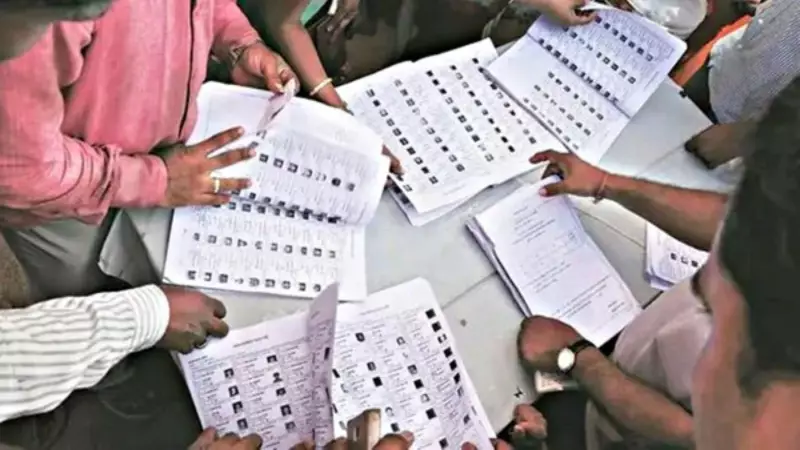
Protests led by the Trinamool Congress (TMC) on Monday brought hearings for the Special Intensive Revision (SIR) of electoral rolls to a halt at multiple locations across West Bengal. The agitation was a direct response to the Election Commission of India's (ECI) decision to exclude Booth Level Agents (BLAs) from the proceedings.
Protests Paralyze Hearings in Multiple Districts
The disruptions, following party leader Abhishek Banerjee's call to resist the move, affected at least three centres. At the Chinsurah-Mogra block office in Hooghly district, TMC MLA Asit Majumdar stopped the SIR hearing for approximately two hours. He demanded that BLAs or representatives of political parties be allowed inside the hearing venue.
Majumdar stated that the protest was carried out on the orders of Abhishek Banerjee, who had issued directions during a virtual meeting with party leaders on Sunday. "We did this according to Abhishek Banerjee’s order," Majumdar affirmed. He argued that Booth Level Officers (BLOs) cannot efficiently complete the enumeration form fill-up process without the assistance of BLAs.

Similar scenes unfolded at the Dhanekhali block office in Hooghly, where TMC MLA Ashima Patra staged a protest. She insisted that BLAs must be permitted during the hearings unless Electoral Registration Officers (EROs) could produce a written order from the ECI barring them. Protests also erupted in Medinipur town of Paschim Medinipur district, stalling a hearing for nearly an hour.
ECI's Stance on Transparency and Exclusion of BLAs
The Election Commission has maintained a firm position on the issue. For the SIR hearings, the ECI has permitted only Booth Level Officers (BLOs), their supervisors, Electoral Registration Officers (EROs), Assistant EROs, and micro-observers to be present. This explicitly excludes BLAs, who are representatives appointed by political parties and were involved in the earlier document collection phase.
A senior ECI official explained that the move was designed to "avoid unnecessary chaos" and ensure transparency in the hearing process. "Those who are part of the hearing process will upload documents provided by electors, so nothing is hidden. There is no need to present BLAs during the hearing of an elector," the official stated.
The SIR process is critical, as it aims to decide the fate of around 32 lakh "unmapped" voters—those whose details did not appear in the 2002 SIR list—along with electors flagged for logical discrepancies like data mismatches.
Unrest Extends to ECI Observer's Visit
Separate tension flared in the Shirakol area of South 24 Parganas during the visit of ECI's special roll observer, C Murugan. When Murugan visited a government school to oversee the hearing process, he was gheraoed by local residents demanding payment of wages under the 100-day work scheme.
During this protest, Murugan's car was allegedly attacked, resulting in a broken door handle. He remained at the spot during the agitation, which lasted around half an hour before police intervened and dispersed the crowd.
While hearings at the Chinsurah-Mogra block office resumed after the two-hour disruption, the protests underscore the heightened political friction in West Bengal surrounding the electoral roll revision process. The TMC's forceful opposition, channeled through its ground-level agents, sets the stage for further confrontations with the election authority in the lead-up to future polls.