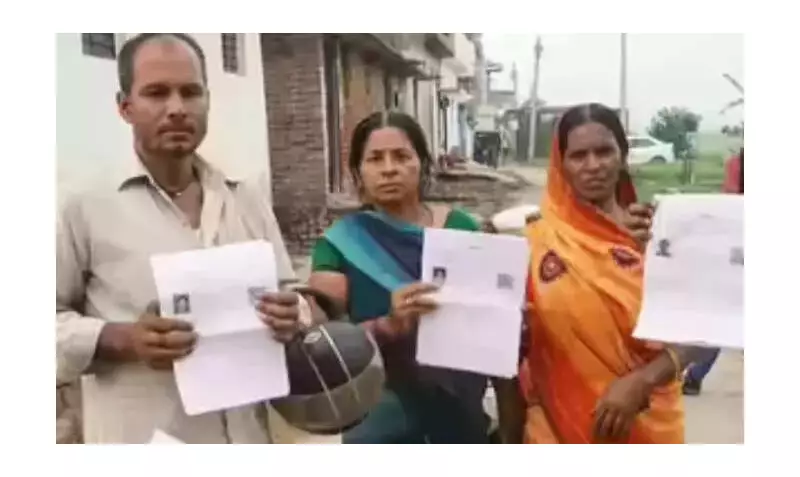
The Election Commission of India has published the draft electoral roll for West Bengal and four other states and union territories, revealing significant discrepancies and leading to the removal of millions of names. The draft, part of the second phase of a Special Intensive Revision (SIR), shows that 7.6% of West Bengal's electorate, or 58 lakh voters, have been deleted from the rolls compiled as of October 29, 2025.
Massive Scale of Discrepancies and Notices
Electoral registration officers (EROs) in West Bengal identified a staggering number of issues. Beyond the 58 lakh deletions, they found that 28 lakh enumeration forms from the last SIR were returned without being mapped to the electoral roll. Furthermore, logical discrepancies were detected in forms submitted by 1.65 crore electors.
This means that a combined total of approximately 1.9 crore electors in the state will be issued notices by the EROs. These individuals must explain the inconsistencies in their records and provide verifying documents. A hearing will be conducted to confirm each voter's status before the final roll is prepared. Those who fail to satisfy the ERO will not be included in the final list.

Reasons for Deletions and District-Wise Variations
The 7.6% deletion rate in West Bengal comprises 3.2% dead electors, 4.3% who have shifted or are absent, and 0.18% enrolled in multiple places. However, the rate varies dramatically across districts. While Purba Medinipur recorded a low of 3.3% deletions, Kolkata North saw a massive 25.9% of its voters struck off. Kolkata South followed with 23.8%, and Paschim Bardhaman had 13.1% deletions.
An interesting pattern emerged in border districts. Seven districts bordering Bangladesh reported deletion rates below the state average, with only North and South 24 Parganas showing higher rates of 9.5%. However, these areas exhibited a high incidence of 'father name mismatch'—a key logical discrepancy. Malda recorded 15.9%, Uttar Dinajpur 15%, and Murshidabad 12.5%. Even Darjeeling, bordering Nepal, had 13.8%, and neighboring Kalimpong reported 19.9%.
Logical Discrepancies and Nationwide Picture
The 'logical discrepancies' that triggered notices include several specific anomalies. Officials found cases where more than six progeny were linked to the same parent in the old roll, electors over 45 years old who had never enrolled, mismatched father's names, and implausible age differences with parents or grandparents.
The draft rolls for other regions under Phase 2 were also published. Rajasthan saw 41.8 lakh (7.6%) of its 5.48 crore electorate removed. Puducherry witnessed the highest exclusion rate at 10.1%, reducing its electorate from 10.2 lakh to 9.18 lakh. Goa had 8.45% of its 11.8 lakh voters deleted, bringing the number down to 10.8 lakh. Lakshadweep's electorate shrank slightly to 56,384 from 57,813 after a 2.47% deletion.
Next Steps and Final Publication
The list of deleted voters has been shared with booth-level agents (BLAs) of political parties and published on the Chief Electoral Officer's website and public offices. Claims and objections can be filed by voters or BLAs until January 15, 2026. The subsequent notice phase, involving hearings and document verification, will continue until February 7, 2026.
The final electoral roll for all five states and union territories is scheduled for publication on February 14, 2026. This extensive revision process aims to create a clean and accurate voter list for future elections.