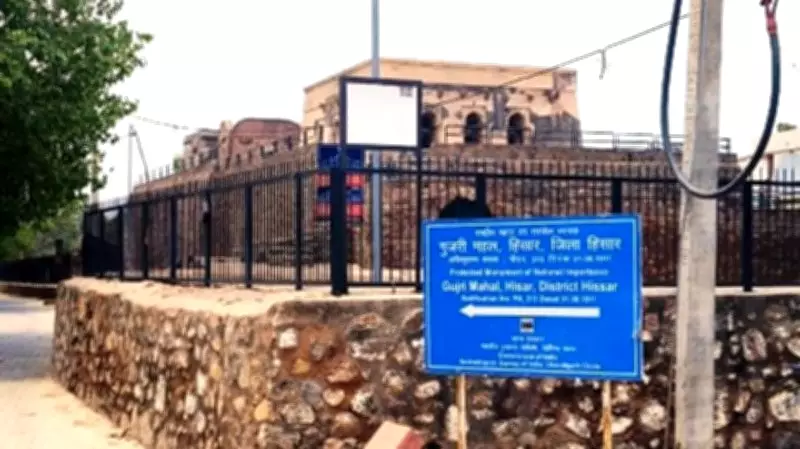
The nearly 680-year-old Gujri Mahal in Hisar, a monument tied to the legendary love story of Delhi Sultan Firoz Shah Tughlaq and Gujri Rani, is set for restoration and development into a major tourist attraction. The project will be executed by the Jindal Group under its Corporate Social Responsibility (CSR) initiative in coordination with the Archaeological Survey of India (ASI).
Project Details and Stakeholders
Lalit Sharma, a representative of the Jindal family, confirmed that discussions with the ASI have already taken place and a joint team has inspected the site. “A detailed project to develop the site as an attractive tourism destination will be prepared soon,” Sharma said. Sources indicate that Independent MLA from Hisar and Jindal Group matriarch Savitri Jindal has taken a keen interest in the initiative and pushed for the restoration.
An information board at the site states that Firoz Shah Tughlaq built the palace for his beloved Gujri Rani, a native of Hisar, after falling in love with her during a hunting expedition. The monument stands on a high plinth and includes underground chambers, a baradari with 12 doorways, and a pavilion. The square baradari features three arches on each side, with all but one entrance originally having stone door frames. The roof consists of nine bays, each topped with a hemispherical dome decorated with lime plaster panelling. Exterior walls above the arches display intricately carved red sandstone brackets.

Legal Protection and Previous Plans
Gujri Mahal is a protected monument under the Ancient Monuments and Archaeological Sites and Remains Act, which prohibits construction within a 100-metre radius. The ASI had earlier proposed installing decorative lighting and CCTV cameras, but the plan never materialised. With Jindal Group support, the agency now aims to transform the centrally located monument, near the main bus stand, into a prominent tourist destination.
Adjacent to Gujri Mahal is the historic Firoz Shah Palace, another medieval structure that has remained off the tourism map despite being in good condition. Declared a monument of historical importance on April 9, 1924, the palace is built of rubble masonry with thick lime plaster. Its arches rest on red sandstone pillars carved in low relief, believed to have been reused from destroyed Hindu temples. The complex includes an open courtyard flanked by two- and three-storeyed structures, a passage in the western hall leading to a terrace used by guards, a mosque, a lat (pillar), and a domed structure.
Historical Significance and Folklore
Historian Dr Mahender Kumar of DN College, quoting historical writings, described the koshak (villa) as so magnificent that “nobody could name its equal.” The villa consisted of richly decorated apartments and is linked to legends, including one that claims anyone who toured the apartments would end up back at the starting point. Dr Kumar explained folklore that Gujri, a young woman from a Gujjar family, rescued Prince Firoz Shah during a hunting expedition before he became Sultan. “Gujri spotted him with his horse in semi-conscious condition and offered him milk. Prince Firoz recovered and safely reached Delhi. After becoming Sultan in 1351, he approached Gujri and asked her to accompany him to Delhi palace, but she refused to leave Hisar. Afterwards, Sultan decided to build a palace in Hisar for his stay.”
When Gujri declined to live with the Sultan in his palace, he built a separate residence for her, now known as Gujri Mahal, about 200 metres away from his own palace. “The two buildings were interconnected with underground channels so that Sultan could meet his beloved whenever he desired. Sultan shifted his base to Hisar for a couple of years after completion of the palace in 1356,” Dr Kumar added.