

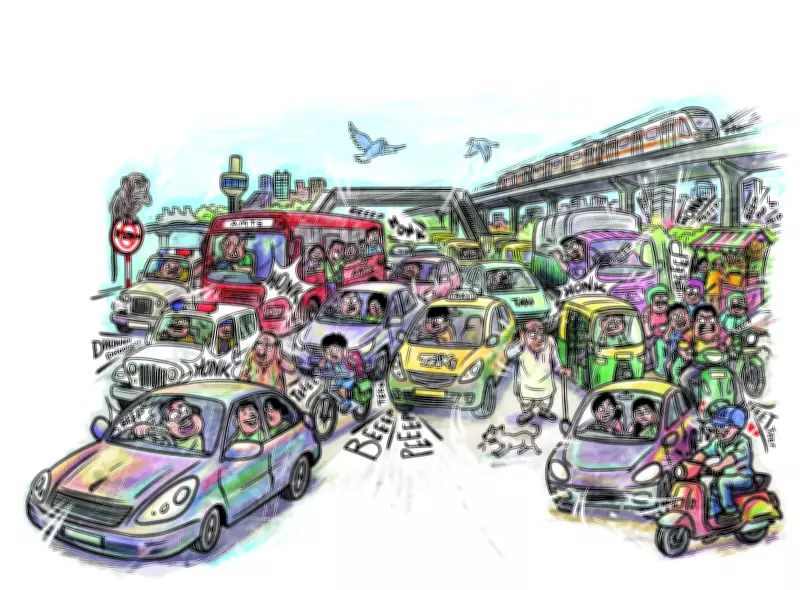
Ahmedabad's Honking Epidemic: 32 Lakh Horn Blasts Analyzed in Groundbreaking Study
In most global cities, the car horn serves as an emergency signal. In Ahmedabad, however, it functions as what researchers describe as a 'metabolic function' of urban life. The constant symphony of rapid beeps and extended blasts tells a compelling story about driving habits, mounting frustrations, and a noise pollution problem amplifying daily. A comprehensive three-year acoustic audit has now transformed this auditory chaos into precise, actionable data.
The Honking Audit: Methodology and Scale
Conducted by technology firm YHonk, founded by Satyen Engineer, Manisha Engineer, Nikki Thakrar, Kumar Abhishek, Nanduri Prashanti, and Nikhil Makwana, the study meticulously tracked an astonishing 32 lakh honking events across Ahmedabad. Researchers employed IoT-enabled devices with SIM cards installed within vehicles spanning four corporate fleets, law enforcement agency vehicles, city buses, and taxis. Every honk was recorded with timestamp accuracy to the second, mapped to GPS coordinates, correlated with vehicle speed at that exact moment, and measured for duration in milliseconds.
Four Honks, Four Personalities: Categorizing Horn Usage
Not all honks are created equal. The study classified every horn blast into one of four distinct types based on duration and inferred intent:

- Type 0: The quickest tap—under 200 milliseconds, roughly a blink's duration—a fleeting nudge to a distracted pedestrian or cyclist.
- Type 1: Lasting 200 to 800 milliseconds, this firm, deliberate press is the instinctive signal for lane changes or approaching vehicle warnings.
- Type 2: Exceeding 800 milliseconds, this prolonged, forceful blast functions less as communication and more as an aggressive shove.
- Type 3: The rapid-fire 'tu-tu-tu-tu' pattern, hammered in bursts less than 200 milliseconds apart, representing the most aggressive honking behavior.
The Superhonkers: Extreme Cases Revealed
The data uncovered extreme individual cases dubbed 'superhonkers.' In one large chemical company fleet recording 13.9 lakh total honks, a single vehicle accounted for a staggering 9.58 lakh horn blasts over 36 months. Another driver in a corporate fleet logged 4.68 lakh honks during the same period. For perspective, a city bus driver was recorded honking 1,019 times during a single 12-hour shift.
Honking patterns followed predictable rhythms: Mondays saw peak volumes at 2.5 lakh honks across studied fleets, tapering to 82,000 by Sundays. Aggressive Type 3 bursts dominated weekdays with 6.15 lakh recorded events. The evening commute between 6pm and 7pm emerged as the most intense period, with one pharma executive's vehicle alone recording 1.71 lakh honks during this hour.
Unexpected Patterns and Behavioral Insights
The largest dataset came from a 75-car taxi aggregator fleet, which recorded 1.34 crore honks over 36 months. Surprisingly, taxi drivers honked more frequently at junctions between 2am and 5am than during the morning rush hour from 8am to 11am, demonstrating that nighttime stillness offers no guarantee of quiet.
Speed significantly influenced honking behavior: at 10-20 kmph, short Type 0 honks comprised 44.2% of all events—quick taps in slow-moving traffic. Above 60 kmph, this share climbed past 60%, likely serving as rapid warnings during overtaking maneuvers. The study confirmed that slower traffic triggers higher irritation, with 3.85 lakh events recorded at 21-30 kmph speeds.
The Cognitive and Infrastructure Factors
"By evening, after eight or nine hours of managing tasks, making decisions, and absorbing information, the brain's capacity for restraint simply runs out," explains Satyen Engineer. "Patience requires spatial awareness, empathy for others, and the ability to delay gratification. Honking requires none of that. It is immediate, physical, and the lowest-effort action available."

For city bus drivers, honking often represents necessity rather than aggression. "A bus is large, slow to brake, and surrounded by blind spots," Engineer notes. "Drivers sit elevated, navigating around two-wheelers, auto-rickshaws squeezing into tight gaps, and unpredictable pedestrian movement." Data substantiates this: across 10 buses on March 13 alone, 3,221 honks were recorded, with one vehicle accounting for 1,019. One bus dashboard showed 54,491 cumulative honking events during its monitoring period.
Noise Pollution Consequences and Proposed Solutions
Multiple studies record Ahmedabad's daytime average noise at around 70 decibels, with a 2023 study finding 76.66% of the city experiences noise at this level. This significantly exceeds WHO guidelines recommending 55-65 dB as daytime reference values for residential and commercial areas.
The study proposes innovative solutions including a 'polluter pays' model where drivers receive a daily quota of free honks (perhaps 200), beyond which penalties apply or the horn temporarily disables until a fee is paid. "It is a radical idea, but one grounded in data," asserts Engineer.
Traffic safety expert Amit Khatri suggests behavioral interventions: "Honking is a behavioral issue. A simple competition can change it. If around 50 corporate executives allow tracking and stay within a 200-honk limit over 15-20 days, the person who honks least wins. With digital certificates, official partners, and social media visibility, this can inspire wider change."
Proven Interventions: The Experiment That Worked
A pilot with a law enforcement agency demonstrated honking habits can change. Eight vehicles monitored over 25 days received automated SMS alerts whenever drivers honked in 986 mapped silent-zone locations. Results were dramatic: honking in silent zones dropped from 1,102 to 650 events (41% reduction). In general zones without alerts, events still decreased from 12,423 to 8,350, suggesting the nudge reshaped overall behavior beyond mere compliance.
Total honking duration nearly halved from 4.65 to 2.38 hours. Aggressive Type 3 bursts fell by 67%. Known hotspots like Rabari Colony and Khokhra saw violations drop to zero. The speed of change proved remarkable: alerts peaked at 191 on November 23 and fell to just 24 by November 28—a simple text message achieving in five days what years of traffic rules could not.
Key Triggers and Five Steps to a Quieter City
The study identified primary honking triggers:
- Herd behavior: Honking proves contagious—when others honk, drivers follow.
- Cognitive fatigue: After long work hours, impulse control drops and the horn becomes an emotional outlet.
- Monday peak: The workweek reset brings stress, delays, and highest honking volumes.
- Festival congestion: During Navratri and Diwali, traffic surges intensify honking.
- Blind spots: Large vehicles use horns as 'sonic radar' to warn unseen traffic.
- Slow-speed frustration: Below 20 kmph, the horn becomes a psychological release valve.
- Night habit: Between 2am and 5am, drivers honk at junctions instead of slowing down.
Researchers propose five actionable steps toward a quieter city:
- Lead by example: Begin with city buses, police, and municipal vehicles.
- Collect baseline data: Run devices silently for a month to map patterns and identify superhonkers.
- Send SMS nudges: Alert drivers only when they honk in silent zones—text only, no penalty initially.
- Utilize the spillover effect: Better behavior in silent zones spreads naturally across the city.
- Enforce with evidence: Once habits shift, activate polluter-pays fines based on collected data.
Startling Statistics and Commuter Perspectives
The research revealed remarkable figures: drivers of one ride-hailing service spent ₹6,650 on 70 liters of fuel solely to power their horns. Nineteen percent of all corporate honking occurs at speeds under 10 kmph—where the horn serves no legitimate safety purpose.
Commuters express growing frustration. "Continuous honking disrupts concentration and breaks train of thought," says Dinesh Pathania. "When someone tries to focus—whether driving, talking, or simply thinking—it becomes very stressful. People should avoid unnecessary honking and be more mindful."
Alpesh Kadwadkar adds: "Honking relentlessly serves no real purpose. No matter how loud or frequent you press that horn, it does nothing to clear the road ahead. Traffic only moves when space becomes available, not because someone keeps honking. Excessive honking is ultimately pointless."
This groundbreaking study transforms anecdotal observations about Ahmedabad's honking culture into empirical evidence, providing both diagnosis and potential remedies for a problem affecting urban livability, public health, and road safety across India's growing metropolitan centers.





