

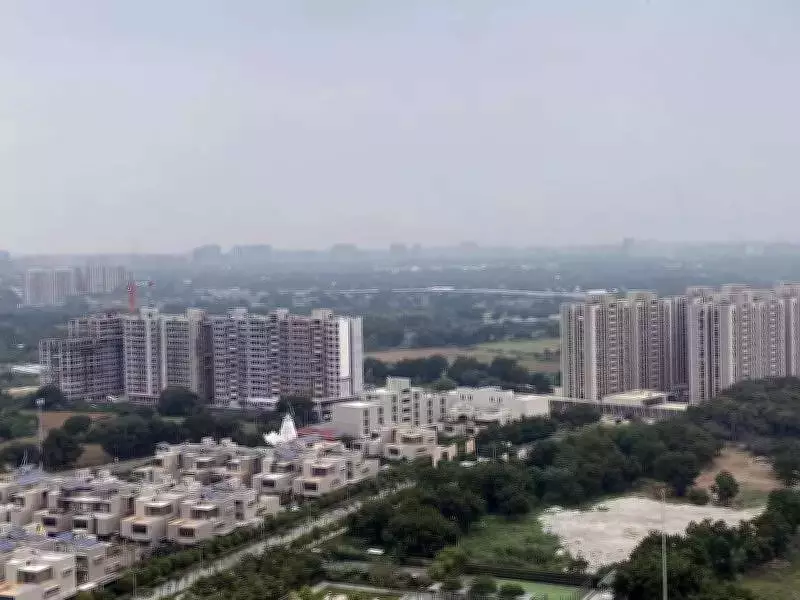
Ahmedabad's Shela Area Grapples with Severe Waterlogging Due to Infrastructure Neglect
In the rapidly developing areas adjacent to Ahmedabad city, a critical issue has emerged: approvals for new residential and commercial buildings are being granted before essential underground utility networks are established. Shela stands as a stark example of this poor planning approach, highlighting systemic failures in urban development.
Decade of Development Without Infrastructure
Over the past ten years, the Ahmedabad Urban Development Authority (AUDA) has approved more than 50 residential and commercial projects around Club O Seven Road and VIP Road in Shela. Residents have already moved into these developments, yet only now is AUDA beginning work on laying crucial stormwater, drainage, and water networks. This delayed infrastructure implementation is causing significant inconvenience to residents not only in Shela but also in neighboring areas including Bhat, Manipur, Godhavi, and Sanathal.
The state government included Shela in AUDA's jurisdiction back in 2009, yet the authority failed to lay a single stormwater line for 15 years. This prolonged negligence has created a perfect storm of urban planning failures that now require urgent and expensive solutions.

Monsoon Misery and Delayed Solutions
Due to AUDA's oversight, Shela, Sanathal, Telav, and Manipur face worsening waterlogging problems every monsoon season. Development permissions were rapidly granted in Shela, Godhavi, Manipur, Sanathal, and Telav without establishing proper stormwater and sewer networks. The consequences became painfully evident on June 30, 2024, when just four inches of rainfall hammered Shela, flooding several localities and disrupting daily life.
An AUDA official, speaking anonymously, confirmed the severity of the situation: "Construction is increasing in areas like Shela, Manipur, Godhavi, Sanathal, and Telav. The lack of sewer and stormwater networks exacerbates waterlogging issues."
Massive Infrastructure Projects Now Underway
AUDA has finally developed a comprehensive master plan with a loan from the Asian Development Bank (ADB) to establish proper stormwater and sewer networks for Shela, Godhavi, Manipur, Sanathal, and Telav. Work has now begun in these areas, though the implementation of the Rs 135 crore project was delayed by a year.
The official elaborated on the ambitious plan: "A master plan was developed to address this, including a stormwater network with an ADB loan, covering approximately 19.7 square kilometers. AUDA will lay 49.4 kilometers of underground stormwater pipelines, 7.6 kilometers of RCC box drains, and establish seven stormwater pumping stations."
Additionally, seven ponds in Shela, Ghuma, Manipur, and Godhavi are being connected to stormwater lines, with water being channeled to the Gota-Godhavi canal through seven water pumping stations.
Contradictions in Development Approval
AUDA approved large residential schemes in Shela's TP Scheme No. 1, where people have already settled, while simultaneously implementing a Rs 240 crore drainage network project. Another AUDA official noted the uneven development pattern: "Residential projects were approved in Shela's TP Scheme No. 1, and people moved in. However, most of TP Scheme No. 2 and 3 areas in Shela, Manipur, and Godhavi remain open."
This piecemeal approach to urban development has created a patchwork of inhabited areas lacking basic infrastructure alongside undeveloped zones, complicating the implementation of comprehensive solutions.
The slapdash nature of current infrastructure works continues to cause gross inconvenience to residents, highlighting the urgent need for coordinated planning between development approvals and essential utility installations. As Ahmedabad's peripheral areas continue to expand, the Shela case serves as a crucial lesson in the importance of infrastructure-first urban development strategies.






