

In a significant administrative achievement, Andhra Pradesh has been recognized as the top-performing state in southern India for its effective and humane execution of the e-KYC process for Mahatma Gandhi National Rural Employment Guarantee Scheme (MGNREGS) job cardholders. The state's approach during the Aadhaar-based verification drive has resulted in the lowest rate of job card deactivations, setting a benchmark for its neighbors.
A Compassionate Strategy Yields Results
The latest data reveals a stark contrast in outcomes. Andhra Pradesh recorded a job card deactivation rate of only 11.4%, a figure substantially lower than those seen in other southern states. This success is attributed to a carefully crafted two-pronged strategy that combined rigorous field mobilization with a strong emphasis on empathy and support for workers.
Commissioner for Panchayat Raj and Rural Development, Krishna Teja Mylavarapu, provided clear assurances to the public. He stated that no genuine worker seeking employment would be excluded. "The moment any worker comes forward and expresses willingness to work under MGNREGS, their job card will be reactivated within 48 hours after completing the pending e-KYC formalities," Mylavarapu explained.

Field Mobilization and Clear Communication
To achieve this, the state deployed dedicated teams of gram rozgar sevaks and digital assistants. These teams conducted door-to-door visits, assisting elderly and migrant workers with Aadhaar seeding and biometric authentication directly at their homes. This on-the-ground effort was crucial in overcoming technological barriers.
Simultaneously, the government launched extensive awareness campaigns in Telugu and local dialects. These campaigns clarified a critical point: deactivation was a temporary administrative step for dormant or duplicate entries, not a punitive measure. This communication helped prevent panic among rural households who depend on the scheme as a social safety net.
Impact on Work Generation and Data Integrity
The ministry of rural development's person-days data highlights the impact of different approaches. While neighboring states experienced sharp declines in work generation—Telangana (-47.37%), Tamil Nadu (-42.78%), and Karnataka (-34.45%)—Andhra Pradesh saw a comparatively modest 19.05% fall. In absolute terms, the state's person-days decreased by approximately 3.74 lakh, balancing fiscal discipline with the preservation of social security.
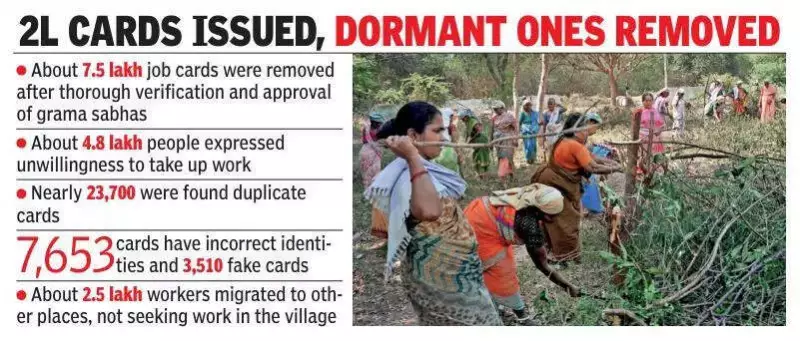
Mylavarapu justified the clean-up, noting that about 6.16 lakh cardholders had not worked a single day in the past year, and 5.5 lakh had zero work days in three years. "We removed only such cards," he said, emphasizing that the purge targeted inactive records. Concurrently, the administration issued nearly 2 lakh new cards in the last 18 months and accepted applications for 1 lakh more at recent grama sabhas.
However, a study by the NGO Libtech India presents a different scale, indicating that nearly 14.2 lakh workers were removed from the rolls in just 42 days, marking an 11.4% fall in total registered workers. The NGO has called for the restoration of all eligible cardholders, pointing to potential discrepancies in the process.
Ultimately, Andhra Pradesh's model demonstrates that efficient governance can be achieved without forfeiting compassion. By ensuring that its rural database remains accurate while actively supporting its citizens through the transition, the state has managed to uphold the core objective of MGNREGS as a reliable safety net for the rural poor.






