

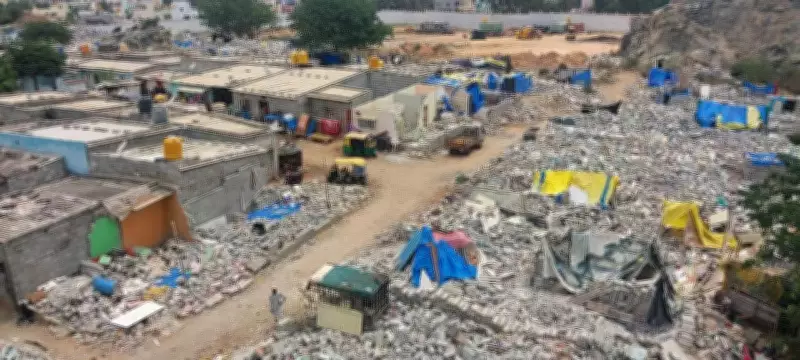
Nearly five months after the demolition of approximately 200 houses in Waseem Layout and Fakir Colony in Yelahanka’s Kogilu area, residents are yet to receive any relief from the authorities. As the Siddaramaiah-led government prepares to mark three years in office, the evicted families have announced an indefinite ‘day-and-night’ protest at Freedom Park starting Monday. The protest is being organized by the Kogilu Slum Nivasigala Horata Samiti, which claims support from organizations working for Dalits, farmers, and workers.
No Resolution Despite Meetings
Nandini K, a member of Dudiyuva Janara Vedike, stated that repeated meetings with local MLA and minister Krishna Byre Gowda have yielded no results. She explained that although housing minister Zameer Ahmed Khan ordered surveys and directed the Rajiv Gandhi Housing Corporation Ltd (RGHCL) to identify eligible residents for alternative housing, many residents lack the six documents mandated by RGHCL. To obtain these documents, residents need school leaving certificates, which many do not possess. The required documents include caste and income certificates, ration card, voter ID, and residence certificate.
Living Conditions Deteriorate
At the demolition site, residents have set up tents and temporary huts that offer little protection from harsh weather. Kaliammal Sudha, a resident of Fakir Colony for five years, said she moved there after her family sold their house near Tannery Road. She lamented that they were preoccupied with work and had no guidance on accessing free sites and houses provided to the poor. Many families she knows have availed such benefits in Hegde Nagar and other places. She added that residents are now forced to relieve themselves in the open after their pit latrines were demolished.

Roshan, an autorickshaw driver, said his family now lives in a rented house opposite his demolished home. With the hike in gas prices, earning a living and paying rent have become even more difficult. Mohammed Fayaz, a driver unable to work after a leg injury, said, “We are ready to leave this place if the government gives us alternative housing. Our homes were demolished without notice.” He added that officials even prevented NGOs from distributing relief such as food.
Political Reactions and Unfulfilled Promises
The demolition was carried out early on December 20, 2025, without notice. The district administration, along with Bengaluru Solid Waste Management Ltd (BSWML), conducted the drive with police protection. On December 21, hundreds protested outside Gowda’s residence near Sahakarnagar. On December 26, the then Kerala chief minister Pinarayi Vijayan posted on X, calling the developments a “brutal normalisation of bulldozer raj,” drawing global attention. Former Kerala MLA KT Jaleel later visited the site. The issue became a political flashpoint between the Congress, CPI(M), and BJP.
Zameer visited the site on December 28 and promised action before the New Year. A three-day survey by RGHCL and the Greater Bengaluru Authority (GBA) followed. While 12 families were allotted homes, residents claimed these were for applications submitted before the demolition. Activists said they have met Gowda three times since, without resolution. Residents recalled leaders across party lines visiting before the elections, but noted that Gowda has not visited since the demolition.
BSWML Plans for the Site
BSWML plans to establish a solid waste processing facility on the five-acre site. The project includes a biomethanation plant, animal rendering and incineration units, and processing plants for sanitary and coconut waste. The biomethanation plant, with a capacity of 50 tonnes, is expected to generate 4–8 tonnes of biogas per 100 tonnes of organic waste, and will be operated and maintained for 15 years. Additionally, four one-tonne animal incineration and rendering units will be set up with a five-year maintenance agreement. A domestic sanitary waste processing unit, in two packages of five-tonne and 10-tonne capacity, will also be established, with a five-year maintenance period extendable by two years, according to BSWML.






