

Bhopal Metro's Parking Plan Redraw Sparks Transport Strategy Debate
The Bhopal Metro has recently redrawn its parking plan, prompting significant debate over how well the system aligns with the city's comprehensive transport plan and the feeder networks originally envisioned to support it. This revision has raised questions about the consistency and long-term vision of urban mobility planning in the capital city of Madhya Pradesh.
Limited Parking Facilities at Operational Stations
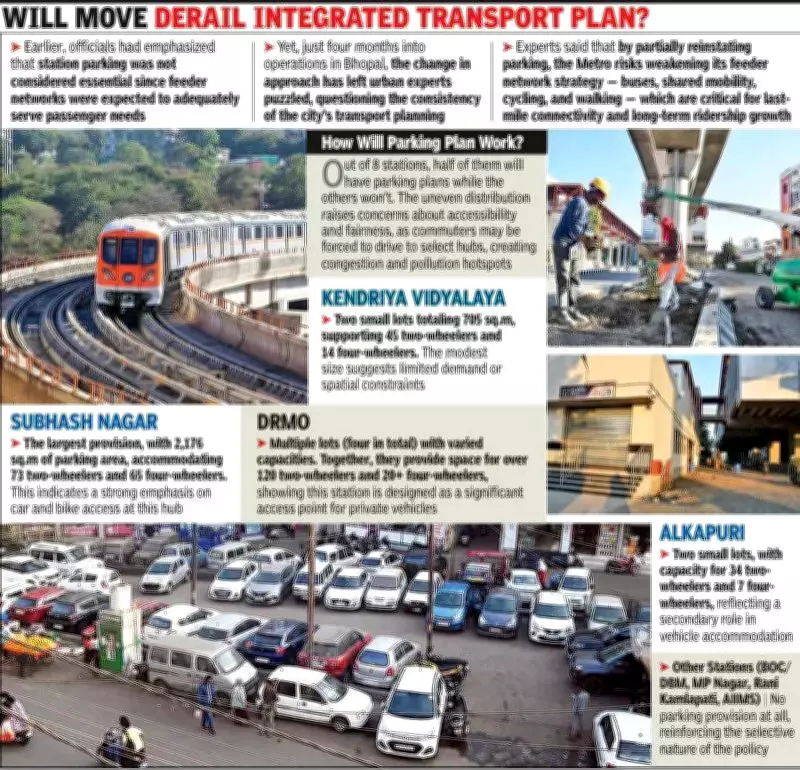
Of the eight new stations where the Metro is currently operational, only four will provide parking facilities:
- Subhash Nagar
- Kendriya Vidyalaya
- DRMO/Habibganj
- Alkapuri
Meanwhile, key transportation hubs including MP Nagar, Board Office, Rani Kamlapati, and AIIMS Bhopal have been left without any designated parking areas. This uneven distribution creates potential accessibility challenges for commuters across different parts of the city.

Contradiction with Original Transport Policy
In the run-up to the Metro's December launch, senior officials from the Madhya Pradesh Metro Rail Corporation Limited (MPMRCL) had emphasized that, under the 2017 metro policy, station parking was not considered essential. The original vision relied on robust feeder networks—including buses, shared mobility options, cycling infrastructure, and pedestrian pathways—to adequately serve passenger needs without requiring extensive parking facilities.
Yet, just four months into operations in Bhopal, this change in approach has left urban experts puzzled and questioning the consistency of the city's transport planning framework. The partial reinstatement of parking facilities appears to contradict the initial strategy that prioritized integrated multimodal connectivity over private vehicle accommodation.
Expert Concerns About Feeder Network Strategy
"By partially reinstating parking, the metro risks weakening its feeder network strategy—buses, shared mobility, cycling, and walking—which are critical for last-mile connectivity and long-term ridership growth," said an urban development expert who requested anonymity. This perspective highlights the tension between accommodating current commuting patterns and building sustainable transportation systems for the future.
The expert further explained that comprehensive feeder networks are essential not just for convenience but for reducing overall traffic congestion, lowering pollution levels, and creating more equitable access to public transportation across socioeconomic groups.
Official Clarification on Parking Facilities
When questioned about the apparent policy shift, a senior MPMRCL official clarified that there has been no fundamental change in policy. They explained that parking facilities are being provided only at Metro stations where adequate space is available within the existing infrastructure constraints.
The official emphasized that the corporation remains committed to developing robust feeder networks as the primary solution for last-mile connectivity, with parking facilities serving as supplementary options where physically feasible without compromising other operational requirements.
Parking Capacity Details at Designated Stations
The parking facilities vary significantly in capacity across the four designated stations:
- Subhash Nagar emerges as the largest parking site, with 2,176 square meters accommodating 73 two-wheelers and 65 cars.
- DRMO/Habibganj follows with multiple lots that together offer space for more than 120 two-wheelers and over 20 cars.
- Kendriya Vidyalaya and Alkapuri provide smaller, more limited facilities suitable for neighborhood commuters.
This tiered approach to parking provision reflects both spatial constraints and anticipated demand patterns at different station locations throughout the Bhopal Metro network.

Accessibility and Environmental Concerns
The uneven distribution of parking facilities raises significant concerns about accessibility and fairness in the transportation system. Commuters without convenient access to the four stations with parking may be forced to drive to these select hubs, potentially creating new congestion and pollution hotspots in the city.
This situation could undermine the Metro's environmental benefits by encouraging longer private vehicle trips to reach stations with parking, rather than promoting shorter feeder journeys via sustainable modes. Urban planners warn that such patterns could exacerbate existing traffic problems in certain corridors while leaving other areas underserved.
The ongoing debate highlights the complex balancing act between immediate commuter convenience and long-term sustainable urban mobility goals. As Bhopal continues to develop its Metro system, the integration of parking facilities with comprehensive feeder networks will remain a critical consideration for transportation planners and policymakers alike.





