Bhopal Metro Faces Staff Realignment Just Weeks After Grand Launch
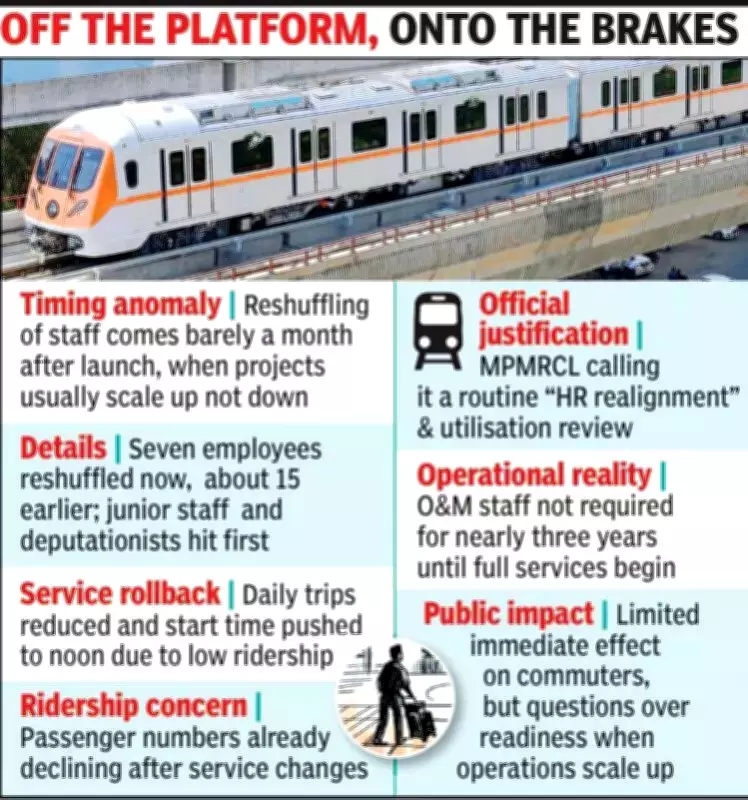
In a surprising development that has raised eyebrows across urban infrastructure circles, the Madhya Pradesh Metro Rail Corporation Limited (MPMRCL) has initiated a significant staff reshuffling exercise barely a month after the much-celebrated launch of the Bhopal Metro project. This move, described by officials as a "realignment" of human resource needs, involves seven employees being reassigned, including three who were on deputation from the prestigious Delhi Metro Rail Corporation.
Details of the Staff Reshuffling Initiative
The reshuffling was officially announced on Saturday, with junior staff members predominantly being sent back to their parent organizations. This follows a similar action taken approximately two weeks earlier, when about fifteen employees were reportedly let go from the corporation. Sources within MPMRCL have indicated that this pattern of workforce adjustment is not isolated but part of a broader strategic review.
According to managing director S Krishna Chaitanya, these changes represent nothing more than a regular assessment of human resource requirements. "We consistently evaluate our manpower needs through structured HR reviews," Chaitanya explained. "Whenever we identify that employees are not being fully utilized in their current roles, appropriate adjustments are made. This is standard practice in any major infrastructure project—once a particular phase concludes, the demand for specific positions naturally decreases."

Operational Timeline and Workforce Implications
Internal sources at MPMRCL have revealed that operation and maintenance staff will not be required in significant numbers for the next three years, until both the Bhopal and Indore Metro systems commence full commercial operations. The Bhopal Metro's 7.2-kilometer priority corridor was inaugurated with considerable fanfare in December 2025, while Indore's 6.3-kilometer stretch opened earlier in May 2025. Full operational capabilities for both networks are projected to be achieved by 2028–29.
Industry analysts have noted that the timing of these staff reductions appears unusual within the context of metro rail projects. Typically, such initiatives expand their workforce following launch to handle increased operational demands, maintenance requirements, and passenger services. The current reshuffling suggests that MPMRCL might be strategically deferring manpower costs during this interim phase, potentially relying more heavily on contractual or outsourced operational models.
Broader Context of Recent Operational Adjustments
This staff realignment follows another significant operational change implemented just a fortnight after the Bhopal Metro's priority corridor began service. MPMRCL reduced the number of daily trips from seventeen to thirteen and shifted the commencement of services from 9 am to noon, citing lower-than-expected ridership figures. These adjustments, which took effect on January 6, have already resulted in a noticeable decline in passenger numbers according to preliminary observations.
The combination of reduced service frequency and workforce reshuffling has prompted questions about the project's current management strategy and long-term viability. While officials maintain that these are routine operational optimizations, the consecutive nature of these decisions within such a short timeframe has drawn attention from transportation experts and urban planners monitoring India's metro expansion initiatives.
As Madhya Pradesh continues to develop its urban transit infrastructure, the management approach adopted by MPMRCL for both the Bhopal and Indore Metro projects will likely serve as a case study for similar initiatives across other Indian cities facing comparable challenges in balancing operational efficiency with workforce management during transitional phases.