Bhopal's Urban Landscape Marred by Dangerous Hazards
The tragic drowning death of a techie in Noida due to an unsafe drain has exposed a Pandora's box of similar hazards lurking in Bhopal. Deep pits, exposed sewer chambers, and open drains perilously close to active roads and footpaths remain unattended in plain view across the city, creating daily risks for residents.
Widespread Hazards Across City Localities
A thorough spot check by TOI uncovered multiple hazardous locations spanning from posh neighborhoods to the outskirts. Manholes caused by broken footpaths, debris from incomplete civic work, and partially dug trenches force both pedestrians and vehicles to navigate traffic in dangerous ways. In numerous stretches, stagnant water collects in open pits while rusted rebar and loose rubble lie scattered casually, highlighting constant dangers for commuters, schoolchildren, and two-wheeler riders.
During nighttime, even in crowded areas like Bittan Market, these hazards become nearly invisible until one is dangerously close. The question arises: are these hazards simply waiting for accidents to happen?

Critical Areas of Concern
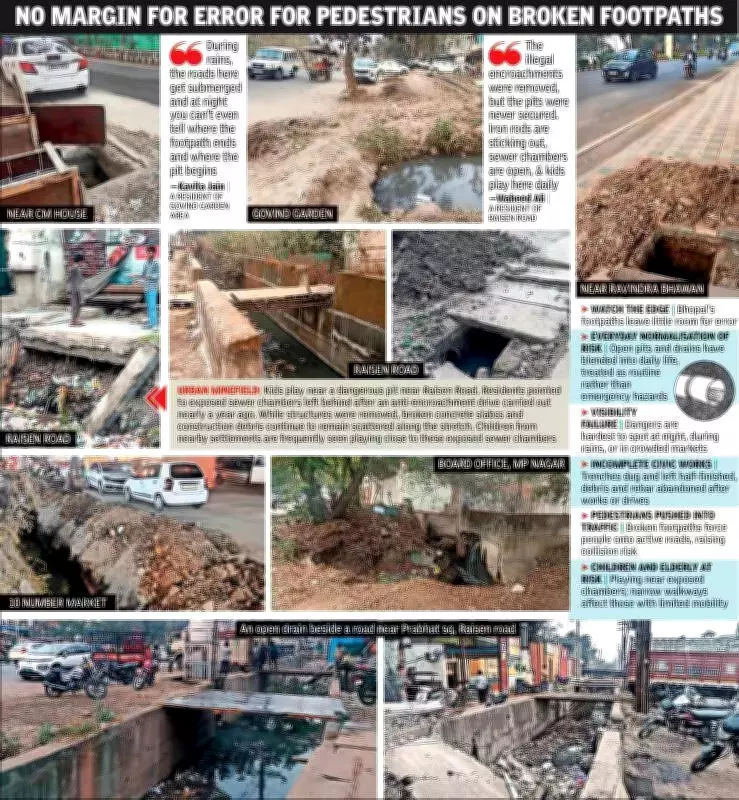
On Lakeview Road, one of Bhopal's busiest arterial stretches located just a short walk from the chief minister's residence, open sewage lines, uncovered pits, and exposed gutters run along the road edges. This poses significant risks to both pedestrians and motorists navigating heavy traffic throughout the day, with walkers forced to use narrow, broken footpaths.
Across several city parts, similar hazards dot both residential and commercial areas. In many instances, civic work appears to have been carried out only partially, leaving behind open pits, exposed drains, and debris that have gradually blended into the urban landscape. Near Ravindra Bhavan, open sewer channels along footpaths have quietly transformed a busy public stretch into a pedestrian hazard. Similar conditions were observed near the Board Office area, where open pits and exposed drains have pushed pedestrians dangerously close to moving traffic.
High-Risk Junctions and Residential Areas
At Prabhat Square, a bustling junction connecting multiple neighborhoods, open pits and drains line pedestrian pathways, forcing people to squeeze past traffic during peak hours. Commuters report that risks escalate dramatically after dusk. "You're constantly watching the road instead of where you're walking," said Anil Sharma, a daily passerby. "One wrong step and you could fall straight into a pit."
On Raisen Road, residents pointed to exposed sewer chambers left behind after an anti-encroachment drive conducted nearly a year ago. While structures were removed, broken concrete slabs, rusted rebar, and construction debris continue to litter the stretch. Children from nearby settlements are frequently seen playing dangerously close to these exposed sewer chambers.
"This was supposed to make the area safer, but it's still dangerous," lamented Waheed Ali, a local resident. "The encroachments were removed, but the pits were never secured. Iron rods are sticking out, sewer chambers are open, and children play here every day."
Vulnerable Populations at Greater Risk
In Govind Garden, uncovered pits along footpaths have significantly narrowed walking space, particularly affecting elderly residents and schoolchildren. Locals note that hazards worsen during monsoon rains when stagnant water collects in open pits, making depth impossible to judge. "During the rains, everything looks the same," explained Kavita Jain, a resident. "You can't tell where the footpath ends and where the pit begins."
Similar hazardous instances were documented in Subhash Nagar and along Raisen Road. At some locations, temporary covers were found damaged, leaving sharp edges and gaps exposed to pedestrians. Even commercial hubs remain vulnerable—near 10 No. Market and in Bittan Market, one careless vehicle turn or rushing pedestrian could prove fatal.
Systemic Issues and Official Response
These near-misses are increasingly brushed aside as the new normal as large city sections remain endlessly dug up due to Metro work, flyovers, civic projects, or private construction—often without visible coordination or adherence to broader master plans.

Responding to mounting concerns, Bhopal Municipal Corporation PRO Prem Shukla stated, "Permanent restoration can't be carried out until testing of the pipeline is completed. Initial filling is temporary, and final restoration is done only after engineers certify the line."
Shukla added that disruption remains inevitable during large-scale projects. "Development work is being carried out for citizens themselves. Temporary inconvenience is part of the process, and once the projects are completed, the city will be more organized and better equipped," he asserted.
Until corrective measures materialize on the ground, uncovered pits, open drains, and exposed sewer chambers continue to line everyday life across some of Bhopal's busiest and most densely used roads, posing persistent threats to public safety.