Bhopal Municipal Corporation Conducts Stray Animal Drive Under Govardhan Project
In a significant move to address urban stray animal concerns, the Bhopal Municipal Corporation (BMC) executed a comprehensive stray animal drive as part of its Govardhan Project. According to an official press release issued on Thursday, BMC staff successfully impounded 27 stray animals from multiple locations across the city.
Operation Details and Animal Relocation
The drive targeted areas including Kokta, Patel Nagar, Anand Nagar, Raisen Road, Karond, Bhanpur, Ayodhya Bypass, Minal Residency, Jail Road, and Mandi. All captured animals were transported to the designated Kanji House facility for temporary holding and processing.
During the operation, BMC's specialized Haka Party removed 25 animals from public streets, provided medical attention by shifting three injured or sick animals to veterinary hospitals, and transferred 20 animals to Shri Krishna Gopal Gaushala for long-term care and shelter.

Official Directives and Legal Framework
Municipal officials confirmed that the drive was conducted under specific instructions from BMC Commissioner Sanskriti Jain, with the primary objective of reducing stray livestock presence on public roads and enhancing urban safety. BMC guidelines explicitly prohibit stray cattle within municipal limits, creating a regulatory framework for such enforcement actions.
The municipal call centre reportedly receives between 250 and 300 complaints monthly regarding stray animals, with approximately half of animal owners reclaiming their impounded livestock. Offenders face legal consequences under both the Animal Torture Act of 1871 and the Madhya Pradesh Animal Control Act of 1976.
Financial Penalties and Shelter Management
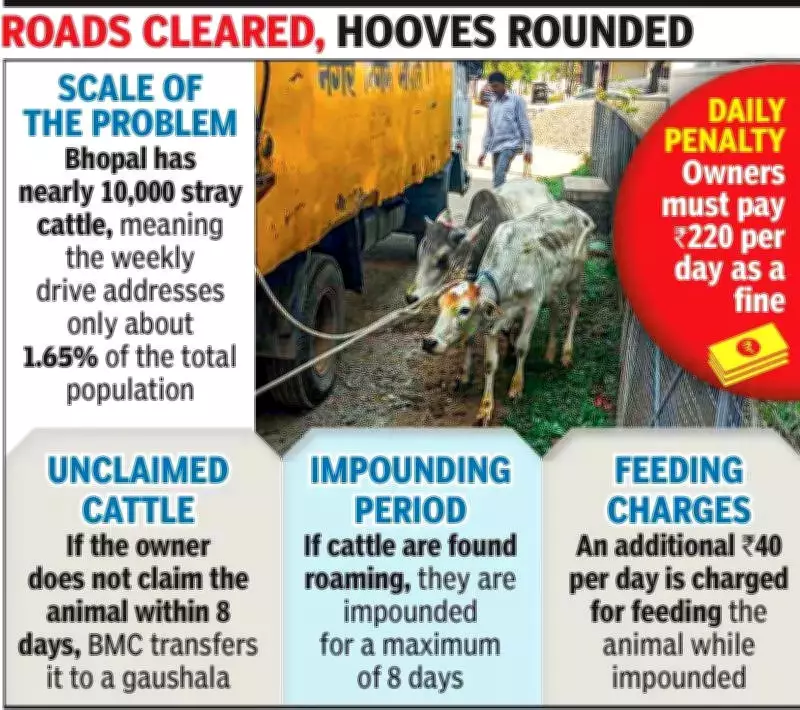
Cattle impounded during these drives are typically held for up to eight days, during which owners must pay fines of Rs 220 per day plus an additional Rs 40 for daily feeding charges. Animals that remain unclaimed after this period are systematically transferred to various gaushalas (cattle shelters) for permanent care.
While BMC does not operate any gaushalas directly, the municipality coordinates with seven Kanji Houses established under the Govardhan Project to manage impounded cattle. The Animal Husbandry Department has maintained cattle tagging records since 2019, with five veterinary hospitals in Bhopal handling approximately 10 medico-legal cases related to animal welfare each month.
Statistical Context and Long-Term Challenges
Between February 16 and 26, BMC operations resulted in 165 stray cattle being sent to Kanji House facilities, averaging about 18 animals captured daily. While these numbers demonstrate consistent operational activity, they represent only a fraction of the broader challenge.
The latest livestock census data reveals that Bhopal has approximately 9,986 stray cattle within municipal boundaries. This means that even a week of intensive drives addresses merely 1.65% of the total stray population, highlighting the substantial gap between enforcement efforts and the scale of the problem.
Officials acknowledge that while regular drives improve immediate road safety and reduce public hazards, achieving sustainable long-term impact requires comprehensive systemic measures. These include expanded shelter capacity, stricter enforcement of ownership regulations, and enhanced public awareness campaigns to address Bhopal's persistent stray cattle management challenges.