

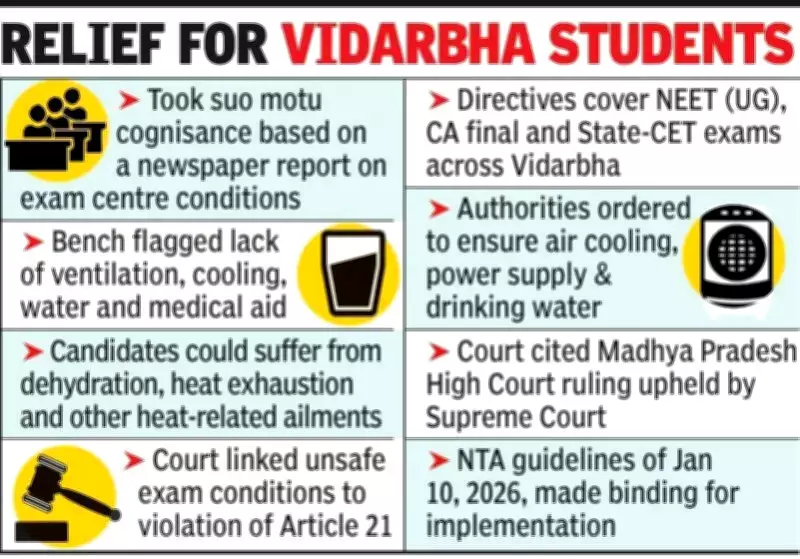
The Nagpur bench of the Bombay High Court on Friday took suo motu cognisance of extreme heatwave conditions leading to infrastructural deficiencies at examination centres in Vidarbha and directed authorities to urgently ensure basic facilities for candidates appearing in major competitive tests, including NEET (UG) scheduled on May 3.
A division bench comprising Justices Anil Kilor and Raj Wakode initiated the Public Interest Litigation after a media report highlighted concerns over arrangements in Vidarbha, particularly in Nagpur, which is experiencing peak summer temperatures hovering around 45 degrees Celsius. The court recorded that similar shortcomings may exist across centres conducting NEET (UG), CA final examinations, and State-CET entrance tests. Aastha Sharma appeared as amicus curiae, while Additional Government Pleader Kalyani Marpakwar pleaded for various government departments and the Deputy Solicitor General of India. Recognising the need for urgent intervention as exams were scheduled for Sunday, the court conducted the hearing on a holiday (Maharashtra Day).
"Having gone through the petition, it is evident that examination centres may not be adequately equipped with essential facilities like proper ventilation, cooling arrangements, access to potable drinking water, and basic medical assistance," the bench observed, warning that candidates could face "risk of dehydration, heat exhaustion, and other heat-related ailments." Terming the issue one of "public importance," the court said it was "not merely one of administrative inadequacy, but one that directly concerns the health and well-being of students." Citing Article 21 of the Constitution, it added that conducting examinations in conditions exposing students to foreseeable health risks "would not be consistent with these constitutional guarantees."

The bench underscored the responsibility of state and examination authorities to ensure safe and fair conditions, noting that any lapse "could also cause great hardship to students who have been preparing since the last couple of years." It cautioned that discomfort during examinations can directly impact performance and long-held academic aspirations.
The court also referred to a 2025 judgment of the Indore bench of the Madhya Pradesh High Court, later upheld by the Supreme Court, which directed authorities to ensure uninterrupted power, proper seating, and cooling arrangements. Quoting the ruling, it noted that students may feel "they could not reach a place they dreamt in life" if such lapses occur. The National Testing Agency took note and issued guidelines on January 10 in line with the earlier judgment.






