Chandigarh Administrator Formalizes Enhanced Financial Powers for Swift Project Execution
In a significant administrative move, Chandigarh Administrator Gulab Chand Kataria has issued a comprehensive follow-up order directing all Union Territory departments to implement revised financial delegation powers. This directive comes weeks after the Central government empowered the Punjab governor and UT administrator to approve schemes and projects worth up to Rs 100 crore.
Streamlining Project Approvals with Expanded Authority
The fresh directive, routed through the finance department, formalizes the enhanced powers and sets the stage for faster project clearances and more efficient on-ground execution. While financial powers of senior officers and bureaucrats have been substantially enhanced, they will be required to strictly adhere to:
- The General Financial Rules (GFR)
- CPWD Code and Works Manual
- Economy instructions
- All other applicable Central government norms
For Public-Private Partnership (PPP) projects, only Government of India guidelines will apply, ensuring uniformity and compliance with national standards.

Revised Financial Delegation Structure
Under the revised delegation issued in February, the financial approval limits have been substantially increased across administrative levels:
- UT Administrator: Can now approve projects up to Rs 100 crore
- Chief Secretary: Empowered to approve projects up to Rs 50 crore
- Administrative Secretaries: Can approve projects up to Rs 20 crore
- Chief Engineer: Authorization for projects up to Rs 3 crore
- Department Heads (HoDs): Empowered to approve works up to Rs 1.5 crore
Significant Increase from Previous Delegation
This represents a substantial enhancement compared to the earlier 2018 delegation, which had significantly lower limits. Under the previous system:
- The then adviser (now chief secretary) held powers ranging from Rs 5 crore to Rs 20 crore depending on functions
- Administrative secretaries had powers from Rs 50 lakh to Rs 5 crore
- Department heads (HoDs) could approve projects from Rs 25 lakh to Rs 1 crore
Officials in the Chandigarh administration explained that "these revised powers are meant to strengthen officers—administrative and technical alike—so that they can take timely financial decisions without procedural bottlenecks, while still following all norms and Central government rules." They further emphasized that "with expanded authority, monitoring of especially developmental works will now be far more aggressive."
Committee Structure for Project Approvals
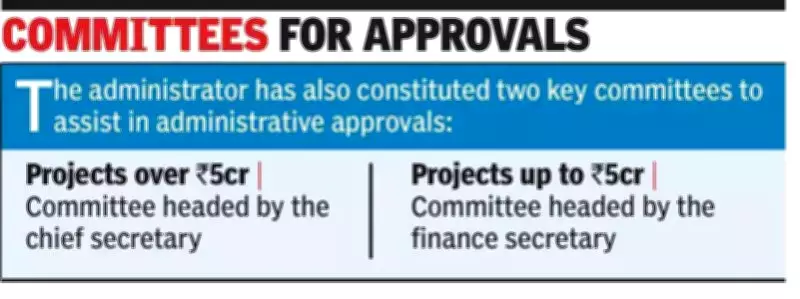
The administrator has also constituted two key committees to assist in administrative approvals:
- Projects over Rs 5 crore: Committee headed by the chief secretary
- Projects up to Rs 5 crore: Committee headed by the finance secretary
This structured approach ensures proper oversight while maintaining the efficiency gains from the enhanced delegation powers. The comprehensive implementation order marks a strategic shift toward more responsive governance and accelerated development in the Union Territory.