

Chandigarh Municipal Corporation Embraces AI with Rs 12 Crore Fund
In a significant move toward technological modernization, the Chandigarh Municipal Corporation has earmarked a dedicated Rs 12 crore fund to integrate Artificial Intelligence into its daily operations. This initiative aims to transform service delivery, from monitoring employee productivity to ensuring efficient doorstep services for residents.
Budget Context and Financial Overview
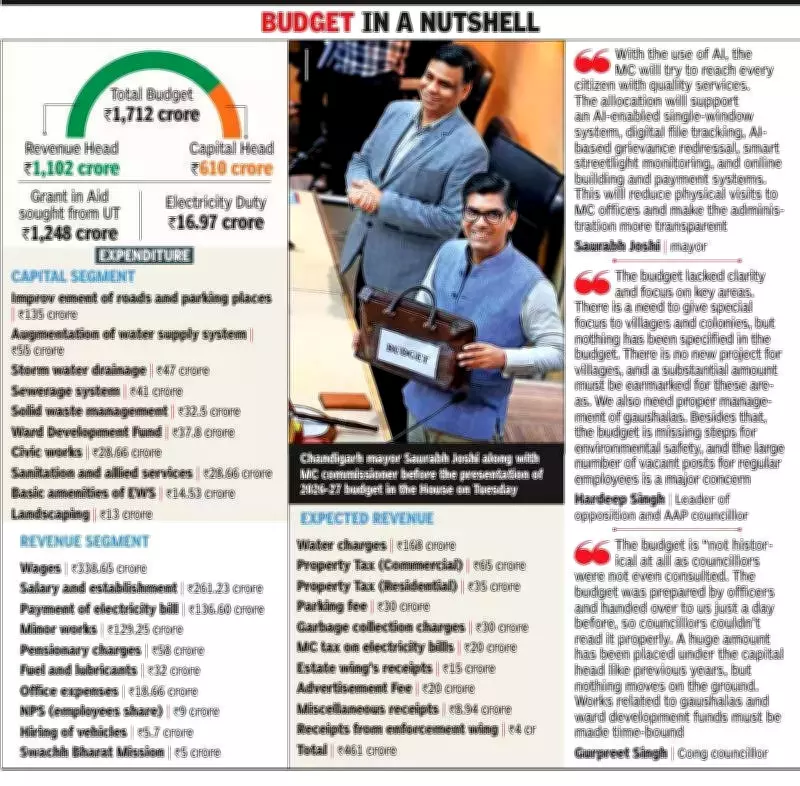
The AI allocation is part of the MC's comprehensive Rs 1,712 crore budget for the fiscal year 2026-27. Despite this substantial budget, the civic body faces a notable deficit of Rs 93.75 crore. Artificial Intelligence emerged as a focal point during budget discussions, which also highlighted improvements in gaushala management, water and sewerage systems, and support for Economically Weaker Sections societies and villages.
Mayor Saurabh Joshi emphasized the priority of embedding AI and technology into municipal functions. "With the use of AI, the MC will try to reach every citizen with quality services. Taking forward the Digital India vision, a provision of Rs 12 crore has been made for AI and IT upgrades for the first time," he stated in his budget speech.

AI Implementation and Digital Enhancements
The Rs 12 crore fund will support a range of AI-driven systems designed to streamline municipal operations and enhance citizen engagement. Key projects include:
- AI-enabled single-window system for seamless service access
- Digital file tracking to improve administrative efficiency
- AI-based grievance redressal mechanisms for faster resolution
- Smart streetlight monitoring for energy conservation
- Online building and payment systems to reduce physical visits
Mayor Joshi added, "This will reduce physical visits to MC offices and make the administration more transparent."
Expanding the Digital Roadmap
Municipal Commissioner Amit Kumar elaborated on the digital initiatives, noting that AI-backed smart paid parking, time-based monitoring of door-to-door garbage collection vehicles, and real-time oversight of water and sewerage systems will be integral to the plan. He mentioned that the Integrated Command and Control Centre will be strengthened, with decisions pending detailed assessments after consulting multiple experts.
Opposition Concerns and Revenue Strategies
During budget discussions, opposition councillors raised critical issues, including gaps in gaushala management and water and sewerage services. They demanded greater attention to EWS societies and villages, which dominated their interventions.
Revenue generation also received significant emphasis. The MC announced a one-time settlement scheme for taxpayers with pending arrears, alongside measures such as digital tax collection, smart parking, and a digital advertising policy. Additional revenue projects proposed under the Public-Private Partnership model include EV charging stations, mobile-tower rentals, and a modern community centre.
Urban Development and Vending Zones
Upgrading vending zones and constructing a model vending zone with essential facilities remained a key agenda item. Councillors stressed that vendors are a vital part of the urban economy and must be provided with proper spaces. Officials confirmed that each vending zone will soon have three bins, with vendors required to maintain their own bins to ensure sanitation.
Comparative Insights: AI in Prayagraj
The Prayagraj Municipal Corporation's rapid adoption of AI for monitoring cleanliness, particularly around the Sangam, has shown promising results. Using AI-powered cameras, PMC tracked garbage-bin fill levels, flagged illegal dumping, and identified waste types for better sorting. This integrated approach allowed real-time oversight of door-to-door collection, sweeping, and disposal functions.
Budget Distribution and Grant-in-Aid Dynamics
Councillors across party lines objected to receiving the bulky budget document only a day before the meeting, arguing it limited their ability to study it thoroughly. They urged the mayor to ensure timely distribution in the future for informed suggestions.

While the MC passed a Rs 1,712 crore budget seeking Rs 1,248 crore in Grant-in-Aid, the UT administration had already announced Rs 850 crore for the civic body weeks earlier. Councillors noted that this makes the GiA request largely a formality, with key financial decisions already taken by the administration.
Political Reactions and Budget Figures
Opposition leaders expressed mixed reactions. AAP councillor Hardeep Singh criticized the budget for lacking clarity and focus on key areas like villages and gaushala management. Congress councillor Gurpreet Singh called the budget "not historical at all," citing insufficient consultation and delayed distribution. In contrast, BJP councillor Maheshinder Singh Sidhu praised the budget for aiming at holistic development, though he emphasized expediting works under the ward development fund.
Budget Figures Overview:
- Total Budget: Rs 1,712 crore
- Capital Head: Rs 610 crore
- Revenue Head: Rs 1,102 crore
- Grant-in-Aid Sought: Rs 1,248 crore
- Electricity Duty: Rs 16.97 crore
Key allocations under the capital segment include Rs 135 crore for road and parking improvements, Rs 55 crore for water supply augmentation, and Rs 37.80 crore for the Ward Development Fund. Revenue segment highlights feature Rs 338.65 crore for wages and Rs 261.23 crore for salary and establishment costs.
Estimated revenue receipts total Rs 461 crore, with water charges contributing Rs 168 crore and property taxes from commercial and residential properties adding Rs 65 crore and Rs 35 crore, respectively.





