

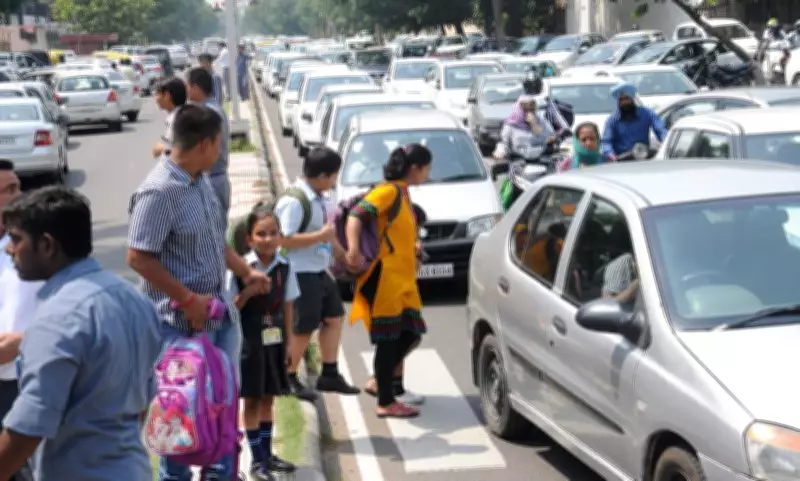
The Chandigarh Administration has launched a crackdown on private schools for converting sanctioned parking areas into other facilities, leading to severe traffic congestion and safety hazards. When schools reopen after summer vacations, the Estate Office will conduct site inspections and take punitive action against violators.
Background of the Issue
Chandigarh has 83 private unaided recognized schools, including 20 minority-run and 63 non-minority institutions. These schools were allotted government land at concessional rates under the Capital of Punjab (Development and Regulation) Act, 1952, with conditions that the land must be used for educational and charitable purposes. The sanctioned building plans required 15% of seats to be reserved free for economically weaker section (EWS) students. However, many schools gradually converted their designated parking areas into sports courts, swimming pools, additional classrooms, lawns, and guard rooms without obtaining revised building plans. This led to a complete loss of internal parking space.
Consequences of Parking Violations
With no internal holding area for vehicles, buses and private cars spilled onto public roads. Parents were forced to stop on carriageways, and children, some as young as four or five, had to navigate live traffic to board or alight. The administration described the chain as: sanctioned parking removed, no internal vehicle holding area, parents stop on public road, children board/deboard on public road, increased accident risk. This daily chaos prompted the implementation of the Safe Transportation Policy for Students (STRAPS).

Who Is Affected
The crackdown impacts lakhs of stakeholders. The 83 private schools enroll hundreds of thousands of students whose parents depend on safe pick-up and drop-off routines. School staff, especially those at gates and on buses, face new mandatory obligations such as supervised boarding inside premises, traffic regulation during peak hours, and one-way circulation enforcement. Non-compliance by staff is considered non-compliance by the school. School managements face the most severe exposure: where parking areas have been physically altered, restoration costs and legal liabilities could be substantial. Deputy Commissioner Nishant Kumar Yadav, also the UT Estate Officer, warned that unauthorized construction will attract action under applicable laws. For schools holding government land on concessional leases, this is a serious threat.
Key Requirements of STRAPS Policy
The STRAPS policy mandates several core requirements:
- All boarding and deboarding of students must take place on school premises under trained staff supervision, not on public roads.
- Schools must maintain an internal holding area with adequate capacity for buses and private vehicles during peak hours.
- Staggered pick-up and drop-off timings may be explored to reduce simultaneous vehicle load.
- Separate entry and exit points must be maintained for vehicle circulation to prevent gridlock.
- One-way traffic management must be enforced around school gates during opening and closing hours to ensure students never cross roads.
- Schools must deploy their own manpower to regulate traffic in their vicinity, not rely on police or civic staff.
These requirements are not new, but the administration is now enforcing them through the Estate Office's sanctioned-plan verification mechanism, providing legal basis to act against schools that altered their layouts.
What Happens Next
The summer vacation is the last grace period. Schools have been directed to acknowledge the administration's directions in writing and use the break to restore all parking violations by demolishing unauthorized constructions and reinstating spaces shown in their sanctioned building plans. When schools reopen, Estate Office teams will conduct site inspections with plans in hand. Any school found in violation will face punitive action without further notice. Additionally, an EWS compliance audit ordered on April 28 remains live, requiring verification that all 83 schools honor their lease obligation to admit 15% of students free of cost. The UT Administration ruled last year that this obligation is constitutional, binding under Articles 21A, 41, 45, and 46.

For parents, the practical implication is straightforward: the roadside chaos should begin to change if enforcement holds. For school managements that treated sanctioned parking as discretionary space, the summer of 2026 may prove to be an expensive reckoning.





