

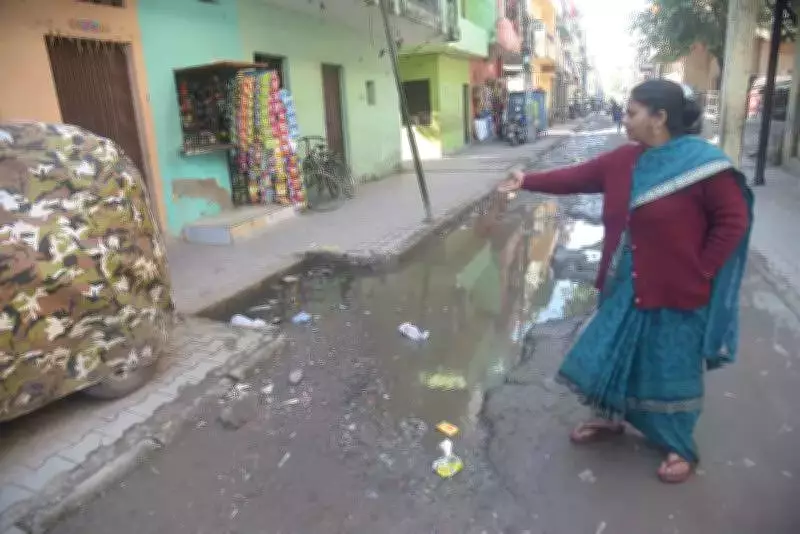
Chandigarh Water Contamination Issues Acknowledged by Central Government
The Central government has formally acknowledged receiving multiple complaints regarding contaminated drinking water in various parts of Chandigarh. This admission came during a parliamentary session in response to a starred question raised by Chandigarh Member of Parliament Manish Tewari in the Lok Sabha.
Minister's Response and Primary Causes Identified
Union Housing and Urban Affairs Minister Manohar Lal Khattar provided detailed responses, confirming that the Chandigarh administration had received specific complaints about water quality issues in areas including Mauli Jagran, Dariya, and Hallo Majra. According to the ministry's assessment, the majority of these incidents involve muddy water rather than confirmed chemical or biological contamination.
The Centre attributed these problems primarily to two factors:

- Ongoing repair works on water supply lines that temporarily disturb sediment
- Operational issues within the aging distribution system infrastructure
The ministry further explained that some residents exacerbate the problem by using private pumps connected directly to distribution lines during non-supply hours. This practice can generate internal pressure at pipe joints, potentially allowing mud and sediment to enter the water supply system.
Testing Results and Immediate Remedial Measures
Authorities have implemented several measures to address water quality concerns. Over the last three months, 1,995 water samples have been collected and tested at laboratories accredited by the National Accreditation Board for Testing and Calibration Laboratories (NABL). The ministry reported that these tests returned satisfactory results.
Immediate actions taken include:
- Regular flushing of water supply lines to remove sediment
- Proper chlorination procedures to maintain potable water quality
- Monitoring of distribution system performance
However, officials acknowledged that Chandigarh's aging water supply system sometimes results in pipeline leakages that compromise water quality.
Long-Term Infrastructure Improvement Plans
For sustainable solutions, the Union Territory administration has developed comprehensive plans to upgrade water infrastructure. These include phased replacement of old and damaged pipelines with modern ductile iron pipelines and connecting areas dependent on groundwater—including Mauli Jagran and Dariya—to canal-based water supply systems.
Under the Centre's Atal Mission for Rejuvenation and Urban Transformation 2.0 (AMRUT 2.0), seven significant projects worth ₹166.39 crore have been initiated in Chandigarh. These encompass:
- Two water supply projects valued at ₹43.77 crore
- Five sewer and septage management projects worth ₹122.62 crore
These ambitious projects will deliver 10.5 kilometers of new water supply network and nearly 240 kilometers of sewer network, including both new installations and replacement of existing infrastructure. The ministry reported that more than 1.76 lakh water tap connections and 2.36 lakh sewer connections have already been provided in the city under AMRUT and related programs.
MP's Criticism and Call for Urgent Action
Despite the government's detailed response, Chandigarh MP Manish Tewari expressed strong dissatisfaction, accusing the administration of understating the seriousness of water contamination issues in rehabilitation colonies.
"The government is being economical with the truth and attempting to cover up a very grave situation," Tewari stated emphatically. He elaborated that in most rehabilitation colonies of Chandigarh, drinking water pipes and sewage lines have corroded over time, and as they lie adjacent to each other, cross-contamination becomes inevitable.
The MP issued an urgent call for comprehensive infrastructure audits: "There is a very urgent need to carry out an audit of the drinking water and sewage lines in all relief and rehabilitation colonies to ascertain the leakages and fix them to prevent a very serious situation from manifesting itself in the future."

Constitutional Responsibilities and Funding Mechanisms
The Centre clarified the constitutional division of responsibilities regarding water supply, noting that it remains primarily a state subject. Operation, maintenance, and replacement of pipelines fall under the jurisdiction of urban local bodies, while the Union government provides financial and technical support through centrally sponsored schemes like AMRUT and AMRUT 2.0.
The ministry also outlined multiple factors that can contribute to contamination in urban water systems, including:
- Pipeline leakages and bursts
- Defective joints in distribution networks
- Cross-connections with sewer lines
- Aging infrastructure deterioration
- Intermittent supply creating negative pressure in pipelines
This parliamentary exchange highlights the ongoing challenges of maintaining water quality in urban centers with aging infrastructure while balancing immediate remedial measures with long-term systemic improvements.





