

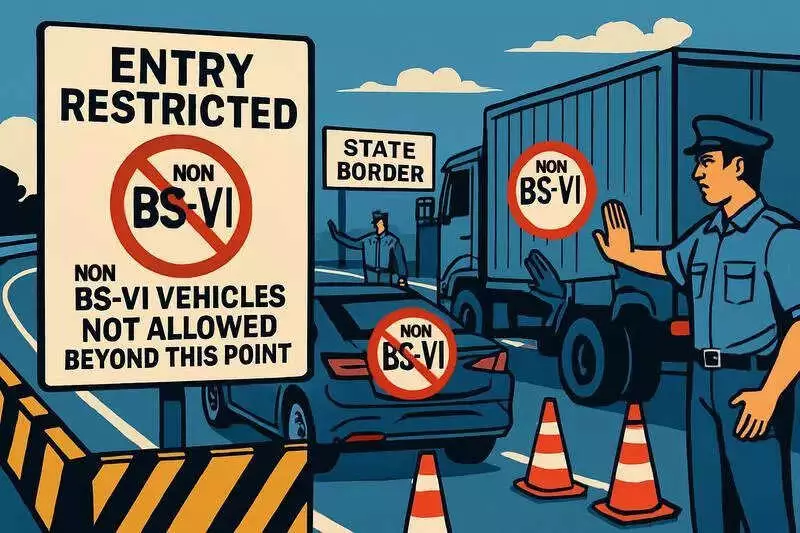
In a stringent move to combat the capital's deteriorating air quality, the Delhi government has now enforced a complete ban on the entry of private vehicles that do not meet the stringent BS VI emission norms and are registered outside the city. The Delhi Traffic Police has ramped up its enforcement machinery, deploying significant resources across major entry points and internal roads to implement the new rule.
Strict Enforcement with Major Deployments
From Thursday onwards, private vehicles registered outside Delhi and complying with older BS III or BS IV emission standards are being prohibited from entering the capital. Announcing the decision on Tuesday, Delhi's Environment Minister, Manjinder Singh Sirsa, warned that any vehicle found violating this ban would be seized by the authorities.
To ensure rigorous compliance, the Delhi Traffic Police has mobilised over 500 personnel and deployed 37 specialised Prakhar vans. These teams have been stationed at key border points and crucial internal corridors. Officials have instructed them to maintain vigilance round the clock to prevent any violations of the new directive.

Part of a Larger Anti-Pollution Drive
This fresh ban is an extension of the ongoing enforcement drive that began when the first stage of the Graded Response Action Plan (GRAP) was activated on October 14. The enforcement actions are backed by substantial penalties under the Motor Vehicles Act.
Driving without a valid Pollution Under Control Certificate (PUCC) attracts a fine of Rs 10,000, while trucks found carrying construction waste without proper covering face a heftier penalty of Rs 20,000. Since the GRAP measures came into effect, traffic police have issued a staggering 1.5 lakh challans specifically for PUCC-related violations.
Scale of Enforcement Revealed in Figures
The recent enforcement statistics highlight the intensity of the checks. So far, authorities have penalised 3,091 light motor vehicles that were compliant with the older BS III and BS IV norms. A significant portion of these, 530 violations, were recorded in just two days—December 14 and 15.
At the capital's borders, the scrutiny has been equally thorough. Police teams inspected 8,236 interstate buses, permitting 7,595 to enter while turning back 641. Furthermore, of the 11,373 trucks checked, 352 were stopped for various violations, with the rest allowed to proceed.
Officials have stated that enforcement will remain stringent in the coming days as air pollution continues to be a serious public health challenge for the National Capital Region. The government is leaving no stone unturned in its efforts to curb vehicular emissions, a major contributor to the city's toxic air.






