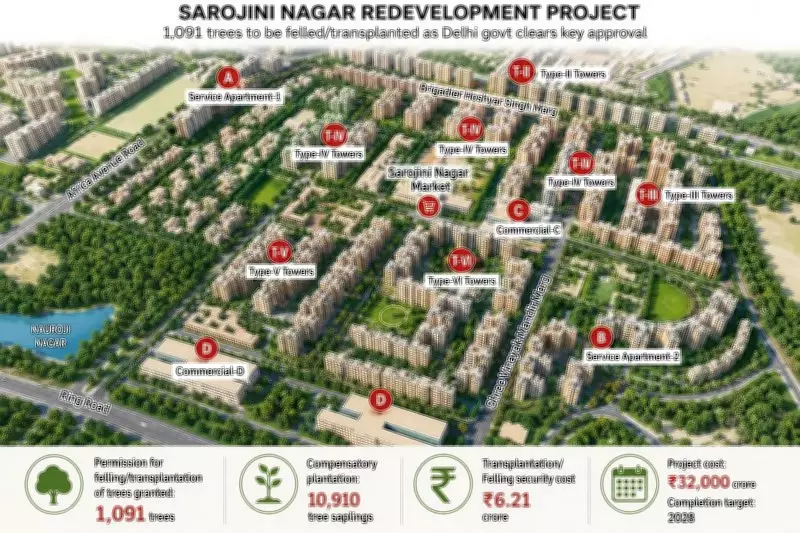
The Delhi Government's Department of Forests and Wildlife has granted approval for the felling or transplantation of 1,091 trees in Sarojini Nagar, removing a key regulatory hurdle for the redevelopment of the General Pool Residential Accommodation (GPRA) Colony. The clearance allows construction to proceed in the remaining undeveloped sections of one of the capital's largest government housing projects.
Tree count reduced through multi-stage review
Officials said the final number of affected trees was significantly reduced after a rigorous assessment process. Initially, a survey identified 1,218 trees on the site. A detailed inspection by the tree officer revised the count to 1,170, saving 48 trees. Subsequently, the Union Central Empowered Committee (CEC), in an order dated May 11, 2026, directed that another 79 trees be retained, bringing the final figure to 1,091 trees that will either be felled or transplanted. The final approval was issued on June 19, according to sources.
Officials associated with the clearance process emphasised that extensive field verification was conducted before any decision was taken, ensuring minimal environmental impact.

Part of larger GPRA redevelopment plan
The Sarojini Nagar redevelopment is part of the Union Government's broader initiative, approved by the Union Cabinet in July 2016, to redevelop seven ageing GPRA colonies across Delhi. Under the programme, Sarojini Nagar, Netaji Nagar and Nauroji Nagar were assigned to NBCC (India) Limited, while Kasturba Nagar, Thyagraj Nagar, Srinivaspuri and Mohammadpur are being redeveloped by the Central Public Works Department (CPWD).
The plan aims to replace nearly 12,970 ageing Type I to IV government quarters with more than 21,000 modern residential units, along with new office space, through a self-financing model supported by commercial development. Sarojini Nagar is among the largest components, featuring high-rise residential towers and the proposed Bharat Business Park commercial hub.
Progress and timeline
Originally built in the 1940s to accommodate Central Government employees, the GPRA colonies are being redeveloped to address the shortage of government housing in the National Capital Region by utilising land more efficiently. The overall redevelopment has progressed in phases over the past decade. Newly-built residential units in Sarojini Nagar and Kasturba Nagar were inaugurated earlier this year as part of a batch of around 2,700 completed homes. Approximately 6,600 more units are planned across the colonies being redeveloped by NBCC and CPWD.
The seven-colony redevelopment programme, estimated at around Rs 32,000 crore, is targeted for substantial completion by 2028. The latest forest clearance removes one of the remaining regulatory requirements for construction in the pending sections of the Sarojini Nagar project, paving the way for the next phase of development.