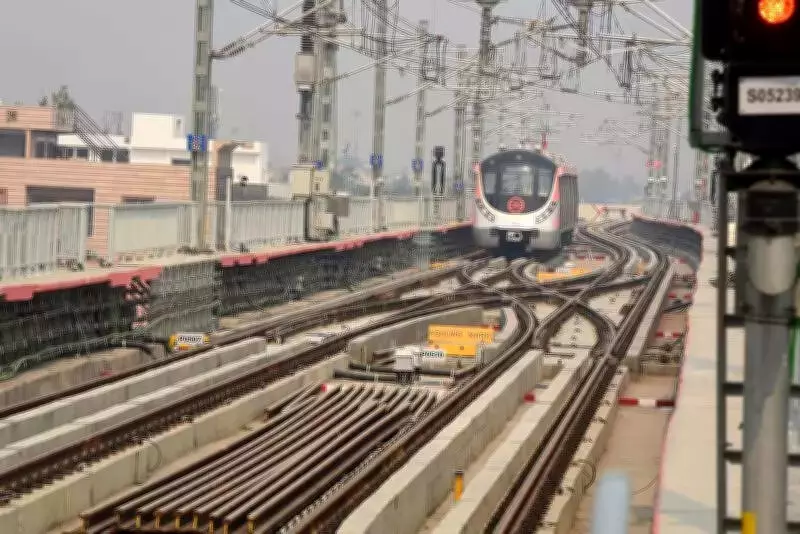
Delhi Metro's Magenta Line Set to Become Longest Corridor with Phase IV Extension
In a significant development for Delhi's urban transport infrastructure, the under-construction 11.9-kilometer Indraprastha–Inderlok corridor of Phase IV will now be implemented as an extension of the Magenta Line, rather than the initially proposed Green Line. This strategic change follows the recent sanctioning of the Phase V (A) corridor from RK Ashram to Indraprastha, reshaping the metro network's connectivity and operational dynamics.
Magenta Line Emerges as Delhi Metro's Longest Corridor
With this extension, the total length of the Magenta Line corridor will expand to 88.4 kilometers, making it the longest in the Delhi Metro Rail Corporation (DMRC) network. The line will now stretch all the way from Botanical Garden to Inderlok, surpassing other major corridors in the system. Previously, the DMRC had announced that the Indraprastha–Inderlok corridor would serve as an extension of the Green Line, which runs from Brigadier Hoshiar Singh to Kirti Nagar or Inderlok. However, the revised plan integrates it into the Magenta Line, enhancing operational efficiency and passenger convenience.
This change positions the Magenta Line ahead of the Pink Line, which currently spans 59.2 kilometers from Majlis Park to Shiv Vihar. Once the Pink Line's Phase IV extension from Majlis Park to Maujpur becomes operational in the coming months, its length will increase to nearly 72 kilometers. Despite this expansion, the Magenta Line will retain its status as the longest corridor, featuring a total of 64 stations along its route.

Enhanced Connectivity and Modern Infrastructure
The integration of the Indraprastha–Inderlok corridor into the Magenta Line brings several infrastructural upgrades. A single station will be constructed at Indraprastha to facilitate seamless passenger interchange with Line 3, commonly known as the Blue Line. Similarly, a new terminal station for the Line 8 extension (Magenta Line) will be planned at Inderlok, integrating with the existing Line 1 (Red Line) and Line 5 (Green Line) stations. This design aims to streamline transfers and reduce congestion at key junctions.
"Since the Indraprastha–Inderlok corridor will now be implemented as an extension of Magenta Line, we are focusing on creating efficient interchange points to enhance passenger experience," explained a DMRC official. "The corridor will operate as an unattended train operations line equipped with a modern signaling system, aligning with our driverless initiatives."
Notably, the entire fleet of trains on the Magenta Line already runs driverless, as reported earlier, showcasing DMRC's commitment to advanced automation and safety standards.
New Stations and Decongestion Efforts
The new Magenta Line extension from RK Ashram Marg to Indraprastha comprises nine strategically located stations:
- RK Ashram Marg
- Shivaji Stadium
- Central Secretariat
- Kartavya Bhawan
- India Gate
- War Memorial-High Court
- Baroda House
- Bharat Mandapam
- Indraprastha
This section significantly boosts interconnectivity, offering more interchanges with other lines:
- Yellow and Violet Lines at Central Secretariat
- Blue Line at Indraprastha
- Airport Line at Shivaji Stadium
To further ease passenger movement, a dedicated subway is proposed between Rajiv Chowk and Shivaji Stadium Metro stations. This will facilitate direct interchange from the Airport Line to Rajiv Chowk on the Blue Line, helping decongest the busy Rajiv Chowk Metro station, a critical hub in Connaught Place.
Broader Phase IV and V Expansion Context
As part of DMRC's Phase IV expansion, six new corridors with a total length of 112.4 kilometers and 94 new stations were originally planned. However, the Union Cabinet recently approved three additional corridors under the Phase V (A) expansion, including:

- RK Ashram Marg to Indraprastha
- Tughlaqabad to Kalindi Kunj
- Aerocity to Terminal-I
These additions reflect the government's ongoing efforts to enhance Delhi's metro network, addressing growing urban mobility needs and reducing traffic congestion. The Magenta Line extension, in particular, is poised to become a backbone corridor, supporting seamless travel across the National Capital Region while incorporating cutting-edge technology for sustainable and efficient public transport.