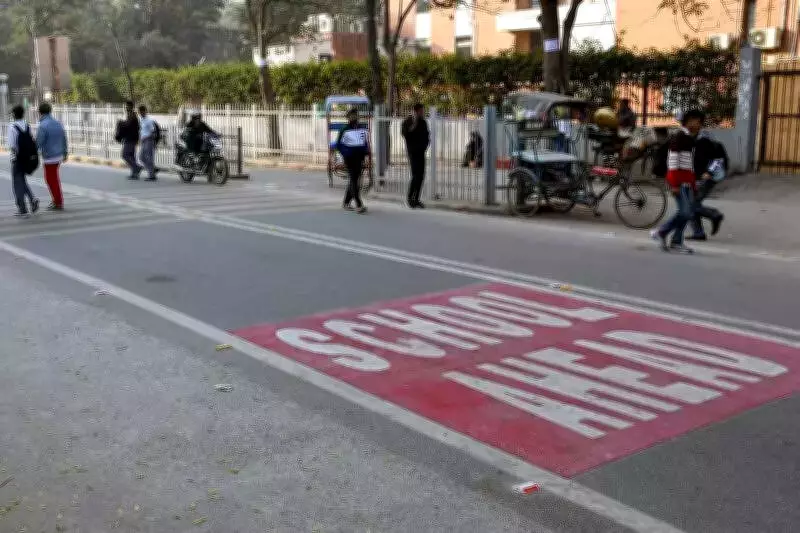
Delhi School Zone Initiative Drastically Reduces Traffic Speeds for Enhanced Child Safety
In Sukhdev Vihar, Delhi, the road outside Dev Samaj School now operates at a significantly calmer pace during school hours. Children with backpacks wait to cross as cars slow down smoothly, and two-wheelers maintain a steady, orderly line, marking a stark contrast to the previous chaotic conditions.
Before the Intervention: A Hazardous Environment
Prior to February, this stretch connecting Okhla Main Road and Mathura Road lacked any safety measures. The carriageway had no central dividers to break its width, and there were no marked crossings to indicate it was a school zone. Footpaths were mostly encroached upon, while vans, autos, and parents' vehicles parked haphazardly, often double-parking during pick-up and drop-off times.
A one-hour traffic survey during morning hours recorded 1,479 vehicles moving in both directions. Speed data collected between 8 a.m. and 10:30 a.m., when children were arriving, revealed dangerously high speeds:

- Two-wheelers averaged 44.1 kmph
- Small cars averaged 42.6 kmph
- Taxis averaged 40.3 kmph
- Vans moved at 37.3 kmph
- Light commercial vehicles reached 35.5 kmph
- Trucks and buses exceeded 32 kmph
- Autos averaged 33.4 kmph
- E-autos neared 30 kmph
- Cycles and other non-motorised vehicles averaged close to 15 kmph
The Redesign: Implementing a School Safe Zone
In response, the Sukhdev Vihar road around the school was redesigned according to Indian Road Congress standards, as part of a pilot 'school safe zone' project. Dr. S. Velmurugan, chief scientist and head of traffic engineering and safety at CSIR-Central Road Research Institute (CSIR-CRRI), explained the comprehensive plan.
The implementation included:
- Parabolic-shaped transverse bar markings (TBMs) of varying thicknesses, made of cold-applied plastic yellow paint
- Markings indicating a 25 kmph speed limit
- Cautionary signs for lane constriction
- Red and white pedestrian markings
- Zig-zag markings extending 25 metres on either side of the school
- Traffic delineation using road studs
- Pedestrian infrastructure improvements
- Access management measures
This project was carried out with corporate social responsibility (CSR) support. On the approach from the CRRI side, six yellow TBM bars were painted first, followed by another six, with three thicker bars added closer to the gate. A similar pattern was applied from the Metro side.
Post-Intervention Results: Significant Speed Reductions
New speed measurements taken during the same morning hours showed dramatic decreases. Vehicles slowed most when traversing the thickest TBMs and approaching the school zone from both directions.
Morning speed reductions included:
- Two-wheelers dropped to almost 30 kmph
- Small cars reduced to 27.5 kmph
- Taxis fell to nearly 27 kmph
- Vans decreased to 24.5 kmph
- Light commercial vehicles slowed to about 22.2 kmph
- Trucks came down to 19.8 kmph
- Buses reduced to 17.7 kmph
- Autos dropped to nearly 20 kmph
- E-autos fell to 15.5 kmph
- Non-motorised transport slowed to just over 5 kmph
Overall, cars and two-wheelers slowed by about 32-35%, truck speeds reduced by 41%, and buses slowed by nearly 45%. Most vehicles now move at or below 25 kmph near the school during morning hours.
Afternoon Improvements and Future Recommendations
The afternoon rush, previously faster with baseline speeds ranging from 30 kmph to 41 kmph depending on vehicle type, also saw substantial improvements. After full implementation with up to 20 mm TBMs, total reductions ranged between 36% and 52%, with cars and two-wheelers showing the highest compliance. Most vehicles now remain within 30 kmph near the school gate during dispersal hours.
Despite these changes, the stretch still carries mixed traffic, with two-wheelers remaining the largest group. Experts recommend that this successful model be implemented at other locations to enhance child safety across urban areas.