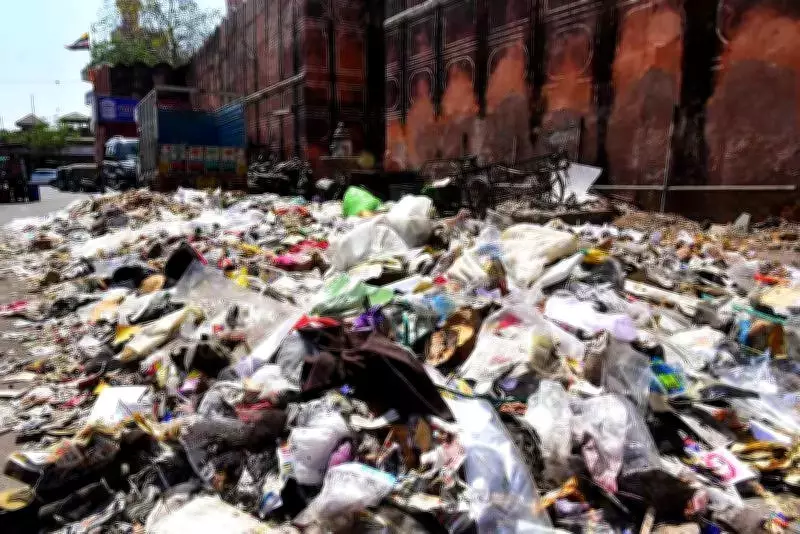
Delhi's Mounting Garbage Crisis: A City Choking on Its Own Waste
For millions of residents across India's capital, the sight of overflowing garbage collection points in busy areas, bins spilling over in bustling markets, and waste accumulating in street corners has become an all-too-familiar and distressing daily reality. The overpowering stench that accompanies these unsightly piles adds another layer of misery to urban life in Delhi, highlighting a deep-seated sanitation crisis.
South Delhi's Neglected Dumping Grounds
In the upscale neighborhood of South Delhi, behind the prestigious Lady Shri Ram College, a dilapidated green metal shed marks what is supposed to be a contained garbage point. Instead, heaps of mixed waste—including plastic, food scraps, cloth, and construction debris—spill far beyond the designated area. The broken structure and muddy, uneven ground are clear indicators of prolonged neglect and irregular waste lifting by municipal authorities.
Amrita, a 19-year-old English Honors student at the college, described the foul smell as unbearable when she first encountered the dumping site. "Now, I have developed a routine. I hold my breath and cover my face with a cloth whenever I am forced to pass by this area," she said, illustrating the daily adaptations residents must make.

Informal Sorting and Traffic Bottlenecks
The situation is equally grim in Greater Kailash, where a roadside garbage dump enclosed by damaged blue metal sheets has transformed into an informal waste sorting zone. Large sacks of recyclable materials lie piled haphazardly, while loose trash spills onto the road itself. As pedestrians, cyclists, and vehicles navigate around the garbage, waste-pickers are frequently seen loading material onto cycle carts, underscoring the city's poor waste segregation and heavy reliance on informal, unregulated waste handling systems.
In Chirag Dilli, the problem manifests as overflowing bins placed along a tree-lined road, resulting in garbage spilling onto both the footpath and the carriageway. This dumping has effectively narrowed a two-lane road into a single usable lane, causing daily traffic congestion along a busy stretch used by commuters traveling between Chirag Dilli and Greater Kailash Part 2. Pedestrians, including numerous college students, report that the stench is so intense it becomes difficult to breathe while crossing the area.
A Widespread Capital-Wide Problem
Residents from various other localities report similar issues. Garbage lies scattered near Turkman Gate, East of Kailash, Shalimar Bagh, Shradhanand Marg, and Burari. In Amrit Vihar, Burari, a narrow stretch is littered with plastic wrappers, paper, cloth, food waste, and debris. Stray cows are often seen feeding on the waste, while pedestrians carefully try to avoid the filth.
In many residential colonies, residents report that designated garbage collection points, known locally as dhalaos, have overflowed onto footpaths and roads. This not only obstructs pedestrian movement but also attracts stray dogs, cows, and pigs, creating additional public health and safety hazards.
Karan Aggarwal, a Resident Welfare Association (RWA) member from East of Kailash, noted that garbage dumps could be spotted every few kilometers in his area. "There are at least five garbage points within a 5 to 7-kilometer stretch, often located right next to parks where people come for morning walks. Instead of enjoying fresh air, they are forced to deal with unbearable stench and filth," he lamented.
Aggarwal also pointed out the traffic implications. "When garbage spreads onto the road, only one vehicle can pass at a time, significantly worsening the already critical traffic situation in these neighborhoods," he explained.
Systemic Failures and Irregular Cleaning
Ashok Basin, president of a north Delhi RWA, stated that residents in areas such as Sabzi Mandi, Ghanta Ghar, Nehru Kutiya, Kabir Basti, and Kishanganj have repeatedly complained about chronic garbage accumulation. "In many of these places, municipal cleaning happens only once every two or three days, which is completely inadequate for the volume of waste generated," he revealed.

B S Vohra, president of the East Delhi RWAs Joint Front, acknowledged some progress, noting that many open dhalaos in east Delhi have been closed over time and replaced with compactor machines. However, he raised significant concerns. "The closure of open dhalaos is a welcome step, but the foul smell emitted by compactor trucks during transit is a serious and unresolved issue. The Municipal Corporation of Delhi must ensure proper sealing, regular maintenance, and thorough sanitation of these vehicles to prevent air pollution and protect public health," Vohra emphasized.
The Scale of the Challenge and Official Response
Delhi generates a staggering nearly 11,000 tonnes of solid waste every single day. While door-to-door waste collection services have expanded across most areas of the city, segregation at source continues to remain a major, unaddressed challenge. Residents from several localities pointed out that despite the installation of separate dry and wet waste bins in many areas, a large number of people simply do not follow basic segregation norms, undermining the entire waste management system.
Sandeep Kapoor, chairperson of the MCD's sanitation committee, asserted that all required facilities, including machinery, vehicles, compactors, and tippers, have already been provided to sanitation staff. "Any lapses found on the ground will invite strict action against area officials, including the sanitary inspector and staff responsible. Instructions have also been issued to identify habitual garbage dumping spots and individuals who continue to dump waste despite warnings. Mapping of such locations is being carried out so that targeted, effective action can be taken," Kapoor stated.
The civic body, he added, is actively working towards making Delhi cleaner and has committed to taking all necessary steps to improve sanitation standards across all areas of the capital. However, the persistent and visible crisis on the ground suggests a significant gap between official claims and the lived reality for Delhi's residents, who continue to navigate a landscape marred by waste and neglect.