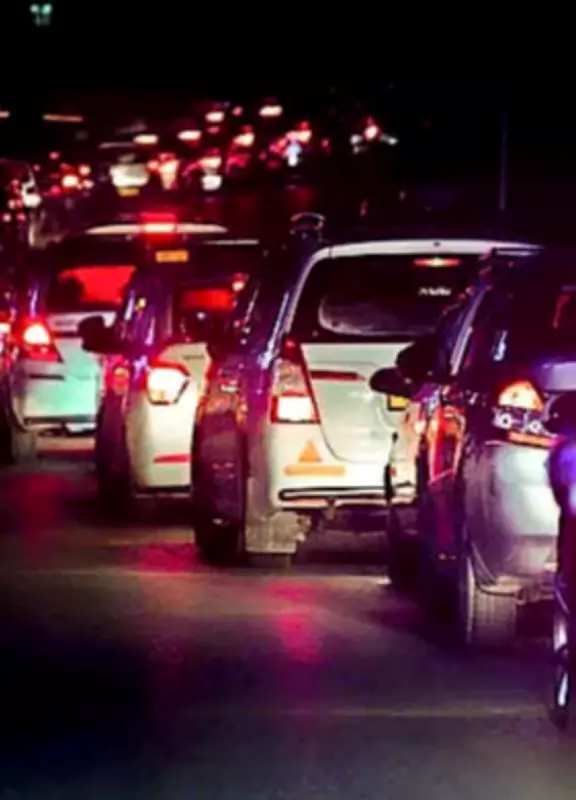
New Delhi: The Economic Survey 2025-26 has strongly advocated for the adoption of targeted 'congestion pricing' in densely populated business districts, coupled with demand-based parking management systems, as a proven strategy to alleviate urban traffic congestion, enhance vehicle speeds, and significantly reduce harmful emissions. Drawing from international examples, the survey underscores how such measures have successfully empowered authorities in global cities like Singapore and London to tackle persistent traffic gridlock effectively.
Long-Standing Proposals Yet to Materialize in Delhi
Despite ongoing efforts dating back to 2009 to propose charging private vehicles for entering key business districts in Delhi—aimed at discouraging non-essential trips during peak hours and promoting public transport usage—this initiative has regrettably failed to transition from proposal to reality. In a notable instance during 2016-17, various Delhi agencies, including the traffic police, were specifically tasked with studying congestion charges as a viable traffic management tool, modeled after London's approach. However, this study too remained unimplemented, highlighting the challenges in translating policy ideas into actionable solutions.
Understanding Congestion Pricing as a Demand-Management Tool
Congestion pricing operates as a sophisticated transportation demand-management strategy, where drivers incur a fee for utilizing roads during peak congestion periods. The core principle involves internalizing the external costs associated with congestion, such as delays, pollution, and fuel wastage, ensuring that those who frequent the most congested roadways bear the true economic burden of their travel. This mechanism is designed to curtail the number of private vehicles on specific congested corridors during high-traffic times, thereby improving overall travel speeds and incentivizing alternatives like public transportation, carpooling, and off-peak travel.

Substantial Productivity Losses Due to Traffic Congestion
The Economic Survey 2025-26 brings to light several alarming estimates of productivity losses across Indian cities, directly attributable to rampant traffic congestion. Referencing a report from the Centre for Science and Environment focused on Delhi's traffic challenges, the survey reveals that an unskilled worker may suffer annual losses ranging between Rs 7,200 and Rs 19,600 due to congestion-related delays. Similarly, skilled and highly skilled workers face even steeper financial impacts, with potential yearly losses of Rs 8,300 to Rs 23,800 and Rs 9,000 to Rs 25,900, respectively.
Broader Economic Implications Across Major Metros
Expanding the analysis beyond Delhi, the survey cites a working paper by the Institute for Social and Economic Change, which estimated that in Bengaluru alone, traffic congestion led to a loss of approximately 7.1 lakh productive hours in 2018 due to late arrivals. This translates into a staggering monetary cost of around Rs 1,170 crore for the city. Furthermore, a 2018 report by UberBCG highlighted that the cumulative costs associated with traffic congestion in India's four major metros—Delhi, Mumbai, Bengaluru, and Kolkata—amount to a substantial Rs 220 crore annually, underscoring the urgent need for effective intervention.
By presenting these compelling data points and advocating for congestion pricing based on global best practices, the Economic Survey 2025-26 positions this strategy as a critical component for sustainable urban mobility and economic efficiency in India's rapidly growing cities.