

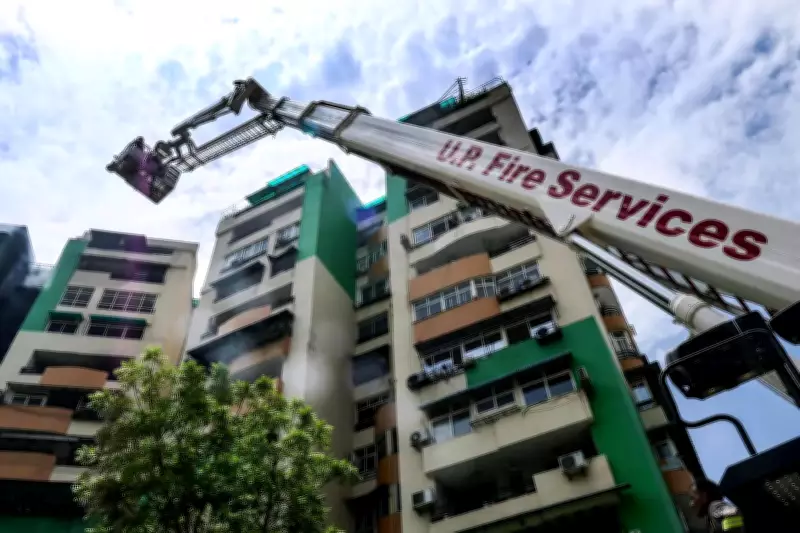
A fire that broke out at Gaur Green Avenue in Ghaziabad has once again brought the preparedness of the fire department in the National Capital Region under scrutiny. As real estate development continues to grow vertically, thousands of residents living on the upper floors of condominiums in NCR remain beyond the reach of firefighting capabilities.
Height Limitations of Firefighting Equipment
In Noida and Ghaziabad, the maximum height that hydraulic cranes can reach is 42 metres, which corresponds to around 14 storeys. However, both cities have residential and commercial buildings as high as 100 metres. The average height of buildings in both cities exceeds 50 metres. In Noida, the tallest building is the 307-metre Supernova with 80 floors, while in Ghaziabad, residential buildings such as Saya Gold Avenue and Apex Drio stand at 120 metres each, with 40 storeys.
Challenges During the Gaur Green Avenue Fire
Hoses mounted on fire engines generally have an effective water stream reach of 60 to 75 metres under ideal conditions. However, practical firefighting at height remains dependent on hydraulic platforms with ladders. At Gaur Green Avenue, water jets initially struggled to reach the ninth floor, and the blaze eventually spread all the way to the 13th floor.

Current Firefighting Resources in Noida and Ghaziabad
The Noida fire department operates nine stations with 28 tenders and four hydraulic cranes stationed at Sector 58, Phase 1, and Surajpur. All of these cranes are capped at a maximum reach of 42 metres. Ghaziabad has five stations, 22 tenders, and a single hydraulic crane of equal capacity, stationed at Vaishali. It was from Vaishali that five engines were rushed to Gaur Green Avenue after the fire was reported around 8:50 am on Wednesday. Two hydraulic cranes, one from Vaishali and another from Noida’s Sector 58 fire station, were deployed later.
Deployment Time and Infrastructure Needs
Ghaziabad Chief Fire Officer Rahul Pal told TOI that hydraulic cranes typically take 15 to 20 minutes to fully deploy after reaching the site. Officials acknowledged the need for infrastructure upgrades. Ghaziabad authorities have already sought higher-capacity equipment, while Noida CFO Pradeep Chaubey said a 75-metre hydraulic platform is being procured. “We should have it in the next three months,” he told TOI. However, in July 2025, the department similarly promised a 100-metre crane “in a few months,” a commitment yet to be fulfilled.
Expert Recommendations for High-Rise Safety
Experts say that as high-rises become the dominant residential model in NCR cities, firefighting will increasingly depend not only on external equipment but also on robust internal safety systems. These include sprinklers, pressurised staircases, smoke extraction systems, and regular evacuation drills. The recent fire incident underscores the urgent need for both immediate equipment upgrades and long-term safety planning to protect residents living in tall buildings across the region.






