

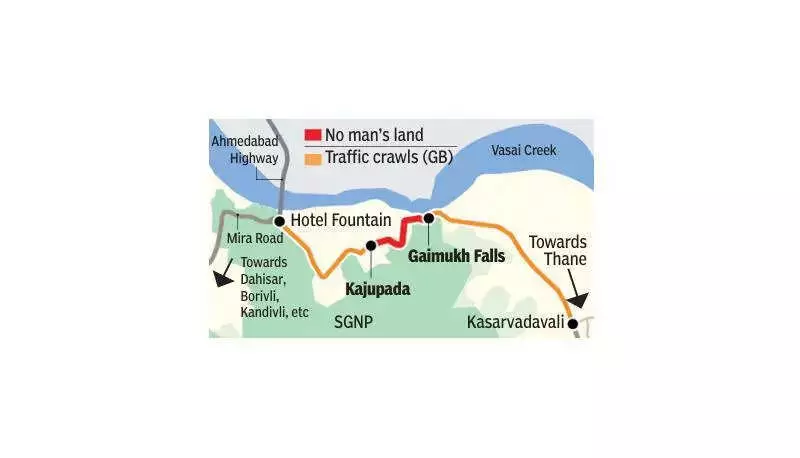
Mumbai's crucial Ghodbunder Road, a vital artery connecting Thane to the Western Suburbs, remains in a state of severe disrepair due to a protracted bureaucratic blame game. A key 9-kilometer stretch, particularly a battered 3-kilometer section cutting through the Sanjay Gandhi National Park (SGNP), has become a nightmare for lakhs of daily commuters, causing hour-long peak-time snarls and spewing pollution over the city's green lung.
The Heart of the Dispute: One Kilometer of "No Man's Land"
For years, three agencies – the Mira Bhayander Municipal Corporation (MBMC), the Thane Municipal Corporation (TMC), and the state Public Works Department (PWD) – have been locked in a tug-of-war over maintenance responsibility. The core conflict revolves around a contentious 1-kilometer patch between the Kajupada Mahadev temple and Gaimukh Falls near J K Infraprojects Ltd, which is the summit point of the hilly SGNP section.
Officials reveal that the road's jurisdiction is technically split: about 4.1km from Hotel Fountain on NH-48 to Landmark Jeep Service Point near Kajupada falls under MBMC limits. The next 4.1km up to the Kasarvadavali flyover is with the state PWD. However, the crucial middle kilometer, originally carved through private property, has become a bureaucratic "no man's land," with neither civic body willing to claim it officially.

Consequences of Neglect: Commuters and Environment Pay the Price
The direct result of this administrative paralysis is a road surface in shambles. A senior PWD engineer explained that the 800m–1km hilltop segment suffers rapid deterioration due to high pressure from heavy vehicles. Compounding the problem is the need for forest clearance for any permanent concretization work, a challenge the agencies have used to pass the buck rather than collaborate on a solution.
Motorists like Swarup Prabhune express frustration at the predictable indifference. "MBMC and TMC each owned 4.1km while the middle kilometre was nobody's responsibility," he said. He noted that the sudden flurry of official activity coincides with repeated public complaints and the approaching local elections. Prabhune highlighted the daily cost of the crawl, estimating that thousands of litres of fuel are wasted daily, exacerbating air pollution in the ecologically sensitive national park zone.
A Directive for Resolution: Splitting the Burden
In a recent intervention, Divisional Commissioner Vijay Suryavanshi has directed MBMC and TMC to split the disputed stretch equally and maintain it jointly, effectively removing the PWD from the equation for this section. He expressed confidence that both corporations would not just re-carpet but also widen the stretch for a permanent fix.
While this directive offers a glimmer of hope, implementation remains uncertain. A PWD engineer indicated that while TMC has verbally agreed to take up the half towards Thane, no formal confirmation letters have been exchanged. Commuters remain cautiously optimistic, viewing this as potential temporary relief while they wait endlessly for the promised long-term solution: the Thane-Borivli tunnel.
The saga of Ghodbunder Road underscores a chronic issue in Mumbai's civic governance, where critical infrastructure fails not due to a lack of resources or technical know-how, but because of an unwillingness to assume responsibility. The resolution of this one-kilometer dispute will be a test of administrative will and its commitment to the city's harried citizens.






