Gujarat's Digital Traffic Enforcement Surge: 29 Online Challans Every 2 Minutes
Gujarat's traffic enforcement landscape is undergoing a quiet yet profound digital transformation, with data revealing a striking surge in technology-led policing. Across the state, an astonishing 29 online challans are issued every two minutes, reflecting not only rising traffic violations but also the rapid expansion of electronic enforcement systems.
January 2025: A Record-Breaking Month for E-Challans
In January 2025 alone, authorities issued 6.89 lakh online challans, translating to a daily average of 22,239. This represents a significant increase from the 2025 daily average of 20,948 challans and nearly doubles the 10,656 daily challans recorded in 2024. Officials attribute this sharp jump to Gujarat's complete transition to the national Parivahan portal, which has streamlined and centralized traffic enforcement data across the state.
What makes these figures particularly telling is that they exclude challans where fines were collected on the spot by traffic police. This means the actual scale of enforcement is even larger than the data suggests, with parallel systems operating simultaneously.

The Technology Behind the Transformation
According to transport officials, the Regional Transport Office (RTO) and traffic police have increasingly shifted to electronic enforcement methods. CCTV cameras, speed guns, and handheld devices now capture violations in real time, significantly reducing dependence on manual checks and improving efficiency.
RTO officials revealed that transport vehicles account for a substantial share of challans, with overloading emerging as the most common offence, closely followed by overspeeding. This technological shift has created a more comprehensive monitoring system that leaves fewer violations undetected.
Urban Centers Lead the Enforcement Charge
The impact of this digital transformation is especially visible in Gujarat's urban centers. Ahmedabad city alone witnessed 40.2 lakh on-the-spot challans issued by traffic police, with motorists paying a staggering Rs 262.6 crore in fines.
The breakdown of violations in Ahmedabad reveals telling patterns:
- Helmetless riding topped the list, generating Rs 134.4 crore in fines
- Wrong-side driving followed with Rs 36.3 crore
- Illegal parking accounted for Rs 34.7 crore
These city-level challans, mostly collected on the spot, are not included in the state's online challan data, highlighting how enforcement operates on multiple parallel tracks.
Exponential Growth in Digital Enforcement
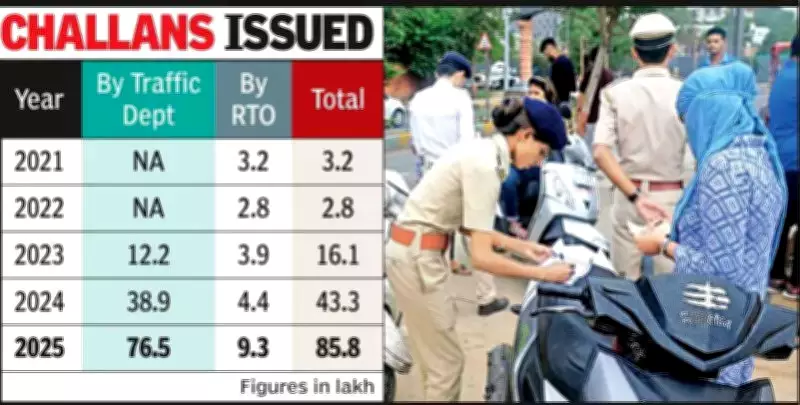
A senior police officer confirmed that the number of challans recorded on the Parivahan website rose by nearly 96% in 2025 compared to 2024. While 38.90 lakh challans were issued in 2024, the figure jumped dramatically to 76.46 lakh in 2025. Just a year earlier, in 2023, the number stood at 12.16 lakh—illustrating how quickly digital enforcement has scaled up across Gujarat.
Expanding Surveillance Beyond Major Cities
This digital expansion is no longer limited to Gujarat's major metropolitan areas. Highways passing through smaller towns now fall under CCTV surveillance networks, with violations detected in these areas also being converted into online challans.
Municipal corporations including Ahmedabad, Surat, Rajkot, Vadodara, Gandhinagar, Bhavnagar, Jamnagar, and Junagadh have established dense camera networks that enable round-the-clock monitoring of traffic movements and violations.
Future Projections and Challenges
Transport officials acknowledge that rising vehicle numbers and increasingly congested roads will inevitably push challan counts higher in coming years. If January 2025's enforcement pace serves as any indication, Gujarat may cross the 1 crore online challan mark this year.
The comprehensive data reveals a clear trajectory of growth in digital traffic enforcement:

- 2025: Traffic Department issued 76.46 lakh challans, RTO issued 9.26 lakh, totaling 85.72 lakh
- 2024: Traffic Department issued 38.90 lakh challans, RTO issued 4.35 lakh, totaling 43.25 lakh
- 2023: Traffic Department issued 12.16 lakh challans, RTO issued 3.88 lakh, totaling 16.04 lakh
This digital transformation represents a fundamental shift in how Gujarat approaches traffic management and enforcement, creating a more systematic, data-driven approach to road safety that spans both urban and rural areas of the state.