Gurgaon and Faridabad Face Severe Sewer Connection Crisis
Beneath the gleaming facade of Gurgaon's glass towers and luxury housing clusters lies a stark sanitation reality. Municipal figures expose that nearly two-thirds of the city's households are not connected to legal sewer lines, highlighting a deep infrastructural divide.
Alarming Statistics Across Haryana Cities
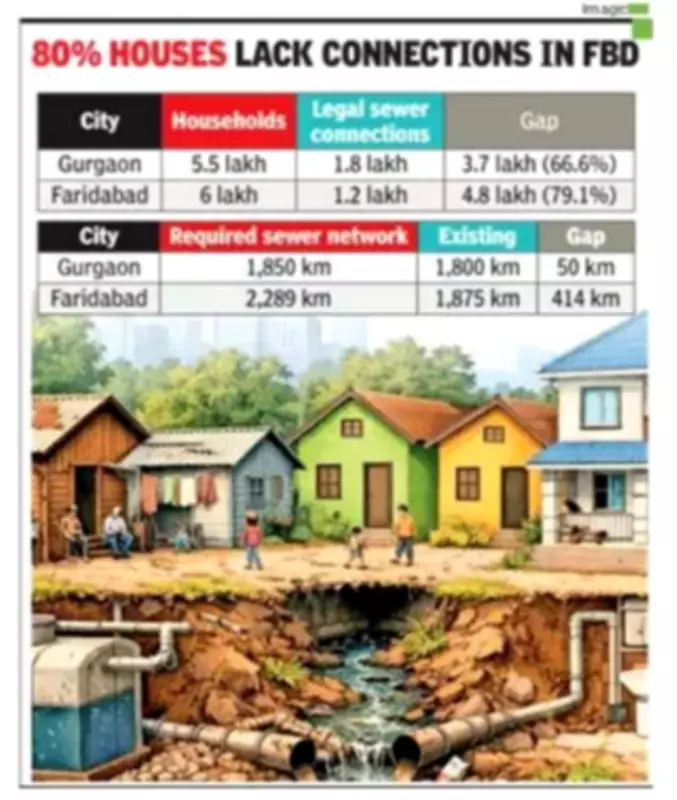
Out of 5.5 lakh households in Gurgaon, only 1.8 lakh have authorised sewer connections. This means a staggering 3.7 lakh homes—66.6%—operate outside the formal sanitation system. Most residents depend on septic tanks or informal disposal channels instead of the official network.
The situation in neighbouring Faridabad is even more severe. With just 1.2 lakh households linked to the official sewer network out of 6 lakh, a whopping 4.8 lakh homes—79.1%—lack legal connections. This leaves only about one in five households within the formal system.

Other Haryana cities also show concerning gaps:
- Sonipat: 52,548 households without legal sewer connections
- Panipat: A gap of 53,044 households
- Karnal: 41,424 households lacking legal connections
Municipal Response and Infrastructure Shortfalls
A senior Municipal Corporation of Gurgaon (MCG) official acknowledged the significant gap, attributing it largely to a previously complicated application process. "We streamlined the system and will launch a portal this week to simplify obtaining authorised sewer connections in the MCG area," the official stated. "Residents will now need only a property ID and a government-issued ID to apply."
The official added that incentives for plumbers to report illegal connections are under consideration to help identify violations and regularise the system.
Infrastructure deficits compound the issue. Gurgaon requires about 1,850 km of sewerage network but currently has roughly 1,800 km, leaving a shortfall of around 50 km. The municipal corporation is preparing an estimate to bridge this gap.
In Faridabad, the requirement stands at 2,289 km, with only 1,875 km available, resulting in a deficit of 414 km. The Municipal Corporation of Faridabad (MCF) has set a deadline of December 2027 to complete the remaining network.
A senior MCF official, requesting anonymity, explained, "Faridabad is an industrial town, and here several residents did not take legal sewer connections. Residents have to pay a certain fee to get their sewerage connections legalised, so they are hesitant. We gave specific directions to our engineers to legalise these sewer connections; otherwise, we have a sewerage network across the city."
Resident Perspectives on a Structural Crisis
Residents highlight that the problem extends beyond illegal connections to a broader infrastructure crisis. Kundan Lal Sharma, a former cabinet secretariat officer and Gurgaon resident, noted, "Density multiplied; towers rose; colonies, authorised and unauthorised, spread, but sewage capacity, like other infrastructure, barely improved."
He added, "Gurgaon expanded exponentially while authorities kept tinkering with plumbing built for a much smaller town. What began as a gap is now a structural crisis, with drains, treatment plants, and aquifers under strain."
This sanitation shortfall underscores the urgent need for enhanced municipal governance and infrastructure development to support Haryana's rapidly urbanising cities.