Gurgaon's Bakhtawar Chowk Underpass Plan Stalls as GMRL Proposes Double-Decker Structure
Gurgaon: The long-awaited infrastructure upgrade at Bakhtawar Chowk has hit a significant roadblock. The Gurugram Metropolitan Development Authority's (GMDA) approved plan to construct a 550-meter underpass at this critical junction has been stalled following a proposal from the Gurugram Metro Rail Limited (GMRL) for an alternative double-decker elevated structure.
From Underpass to Elevated Structure: A Shift in Strategy
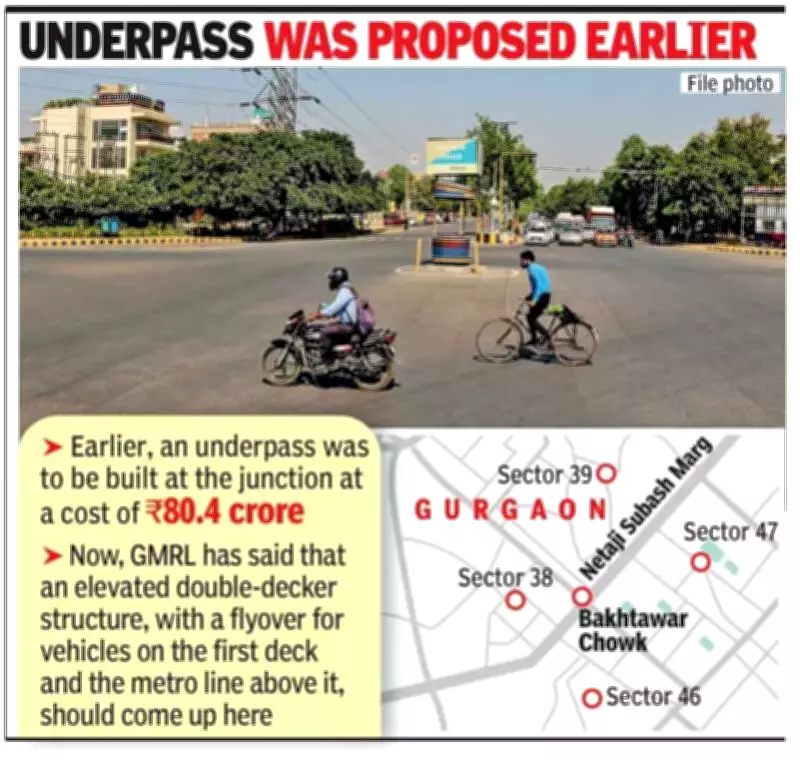
GMDA had finalized and cleared a revised design in January 2023 for a six-lane underpass with additional side lanes, allocating Rs 80 crore for the project. The authority was to provide funding while GMRL would handle execution. However, metro officials have now raised substantial concerns about the underground approach.
"If we go ahead with the underpass, we will permanently consume space on this road," explained a GMRL official. "A large portion of the carriageway will be blocked for ramps and access, and surface traffic will be pushed onto already constrained service roads. In practical terms, we lose valuable road width without fully solving congestion."

Why GMRL Favors the Double-Decker Solution
GMRL's proposed alternative features a double-decker structure with a flyover for vehicles on the first deck and the planned metro line above it. Officials argue this design offers multiple advantages:
- Better Space Utilization: Nearly 70% of traffic could shift to the elevated structure while 100% of surface area remains available for local movement
- Waterlogging Resilience: Elevated structures avoid operational disruptions during Gurgaon's frequent heavy rains
- Future Expansion Capability: Additional connections or ramps can be integrated without disturbing existing traffic flow
- Long-Term Traffic Management: Vehicles not needing intersection access can bypass it entirely on the upper level
"An elevated structure will be better suited for future road expansion plans," the GMRL official emphasized. "An underpass limits surface movement, whereas a viaduct provides more flexibility for local traffic."
Bakhtawar Chowk: A Critical Traffic Nexus
Bakhtawar Chowk represents a major junction on Netaji Subhash Marg and forms part of Gurgaon's proposed inner ring road. It connects multiple important locations including Atul Kataria Chowk, Signature Tower, Millennium City Centre, Hero Honda Chowk, Basai Chowk, the railway station, and sectors 3, 4, 5, and 7.
Current traffic assessments reveal the intersection handles more than 10,000 passenger car units during peak hours, with significant inflow from Millennium City Centre, Subhash Chowk, Chaudhary Bakhtawar Singh Road, and Satpaul Mittal Road. Traffic volumes are expected to increase further with the upcoming IKEA store in Sector 47.
Project History and Current Status
The infrastructure improvement at Bakhtawar Chowk has followed a winding path:
- A flyover was first proposed in April 2021 under GMDA's decongestion plan
- The plan was revised to an underpass in 2023
- Work did not begin due to uncertainty over metro corridor alignment
- GMRL was assigned execution responsibility in April 2023
Of six planned upgrades under the inner ring road plan, four have been completed. Work at Bakhtawar Chowk and on the stretch between Hero Honda Chowk and Umang Bhardwaj Chowk remains pending.
GMDA officials stated they have finalized the underpass design and have not yet received a formal double-decker proposal for Bakhtawar Chowk. The proposal is likely to be discussed in a joint GMDA-GMRL meeting.
Broader Infrastructure Implications
This development at Bakhtawar Chowk occurs alongside other infrastructure planning. GMRL has agreed to plan a 1.2-kilometer double-decker section on Old Delhi-Gurgaon Road, where the phase-2 metro alignment overlaps with GMDA's proposed elevated corridor between Atul Kataria Chowk and Dundahera.
The junction is also slated to host the proposed Sector 47 metro station on the Millennium City Centre–Cyber City corridor, adding another layer of complexity to the infrastructure planning.

As Gurgaon continues its rapid urban development, the decision at Bakhtawar Chowk will set important precedents for how the city manages its limited space while addressing both current congestion and future growth needs.