Gurgaon's Green Transport Lag: Electric Buses Remain Elusive as CNG Fleet Continues
In a stark contrast to neighboring Delhi's aggressive push toward electric public transportation, Gurgaon's bus service continues to operate entirely on Compressed Natural Gas (CNG). While Delhi has positioned electric buses as the cornerstone of its public transport transformation, Gurgaon's transition to a greener fleet has been largely confined to electric cabs and auto-rickshaws, leaving its core bus network unchanged.
Policy and Implementation Hurdles Slow Haryana's Progress
Amit Bhatt, India managing director at the International Council on Clean Transportation (ICCT), explained the disparity to TOI. "Delhi's progress was driven by faster execution and robust policy support," he noted. "The capital benefited significantly from central schemes like FAME II (Faster Adoption and Manufacturing of Hybrid & Electric Vehicles in India) and the PM e-Drive initiative, coupled with superior planning and quicker implementation."
Bhatt emphasized that while Haryana qualifies for the same central schemes, critical reforms are missing. "A proper payment security mechanism and a structured implementation framework are essential," he stated. "Without these foundational elements, cities struggle to get projects approved and executed on the ground."

Limited EV Traction in Shared Mobility Segment
Over the past decade, Gurgaon has witnessed only modest adoption of electric vehicles in the shared mobility sector. Official data reveals:
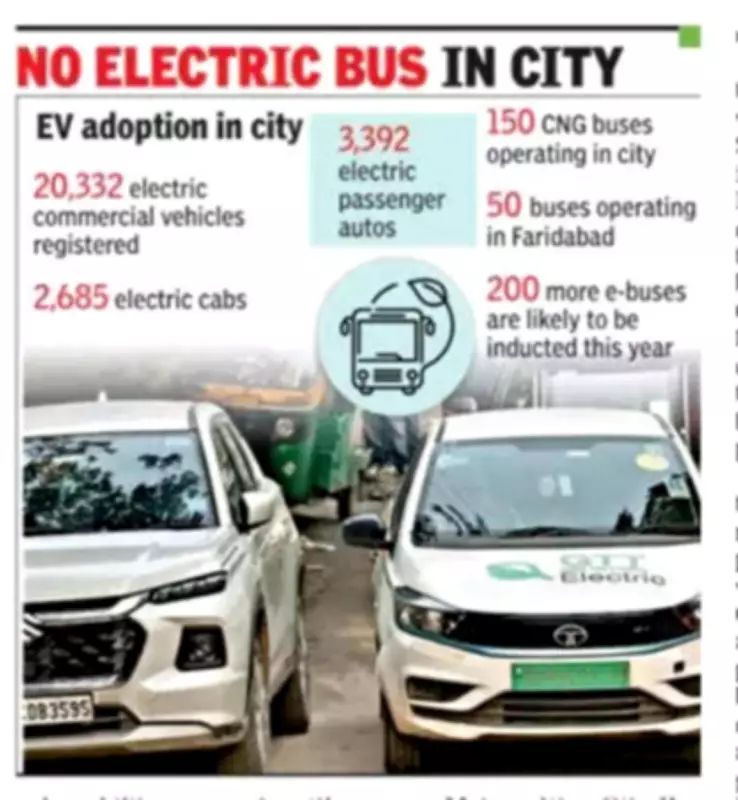
- 20,332 electric commercial vehicles registered to date
- This includes 2,685 electric cabs and 3,392 electric passenger autos
- Together, e-cabs and e-autos constitute nearly 30% of Gurgaon's registered commercial EV base
This indicates that last-mile connectivity and app-based mobility services are beginning to embrace electrification, while the backbone bus service lags behind.
Failed Attempts and Delayed Rollouts Since 2019
Despite multiple initiatives, the Gurugram Metropolitan City Bus Limited (GMCBL) has failed to introduce a single electric bus into its fleet since 2019. The first serious attempt began in September 2019 when GMCBL floated a Request for Expression of Interest (RFEOI) to deploy 100 electric buses across the city.
This plan was subsequently shelved after the Haryana government decided to pursue statewide bus procurement instead of city-specific deployments. In 2023, the state enrolled in the PM e-Sewa scheme, with Convergence Energy Services Ltd (CESL) appointed to facilitate deployment.
Key developments include:
- In February 2025, CESL finalized a concessionaire to procure, operate, and maintain 450 electric buses across Haryana, with Gurgaon slated to receive 100
- An additional 100 e-buses were confirmed in September 2025
Despite these announcements, the electric buses have yet to transition from planning documents to actual road operations.
Awaiting Government Approval for Final Implementation
According to the Gurugram Metropolitan Development Authority (GMDA), CESL has finalized the gross cost contract, but the proposal awaits government approval. Only after this clearance can GMCBL sign the formal agreement and commence the rollout process.
Officials indicated that the proposal is likely to be presented before the high-powered purchase committee on Monday and is expected to receive the government's endorsement. However, the originally scheduled timeline for e-bus induction has already been missed, further delaying Gurgaon's green public transport ambitions.
The continued reliance on CNG buses highlights the implementation challenges facing Haryana's urban centers, even as Delhi demonstrates what coordinated policy support and execution can achieve in the electric mobility sector.