In a significant development for residents of Hyderabad and across Telangana, the state electricity regulatory body has introduced fixed charges for electricity connections, providing substantial financial relief to consumers, particularly those in newly developed areas and city outskirts.
Regulatory Intervention Brings Financial Relief
The Telangana State Electricity Regulatory Commission (TGERC) has taken a decisive step to address the long-standing issue of exorbitant electricity connection charges that have burdened consumers for years. Through a gazette notification issued on Wednesday, the commission has established clear, fixed rates for erecting power infrastructure and distribution systems, especially in peripheral urban areas where existing networks are absent.
Ending Arbitrary Charges
Previously, electricity distribution companies (discoms) in Telangana had the discretion to levy substantial charges for installing transformers, poles, and other essential infrastructure needed to extend power supply from main lines to consumers' premises. These costs, which varied based on distance and specific requirements, often escalated to several lakhs of rupees, creating significant financial hurdles for individuals seeking domestic connections.

The situation was particularly challenging for residents of new residential colonies on Hyderabad's outskirts and agricultural consumers, who were sometimes required to bear the entire cost of poles and transformers. This arbitrary system created uncertainty and financial strain for many households and businesses across the state.
New Fixed Charge Structure
The TGERC's new regulations establish a transparent, tiered pricing system for electricity connections:
For Domestic Connections
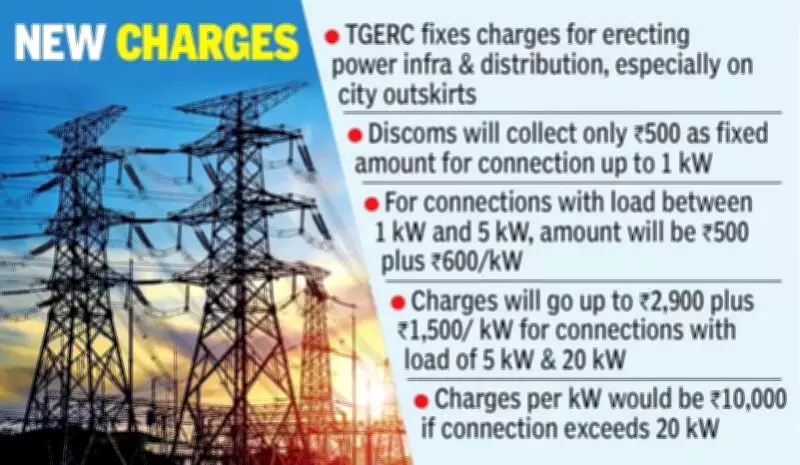
- Up to 1 kW: Fixed charge of ₹500
- 1 kW to 5 kW: ₹500 plus ₹600 per kW
- 5 kW to 20 kW: ₹2,900 plus ₹1,500 per kW
- Above 20 kW: ₹10,000 per kW
For Non-Domestic Connections
- Up to 1 kW: Fixed charge of ₹1,000
- 1 kW to 5 kW: ₹1,000 plus ₹2,000 per kW
- 5 kW to 20 kW: ₹5,800 fixed charge plus ₹2,000 per kW
For Agricultural Connections
Discoms can collect a maximum of ₹1,000 per kW from agricultural consumers, providing much-needed relief to the farming community.
Clarity on Infrastructure Responsibilities
The regulatory commission has provided crucial clarifications regarding infrastructure responsibilities:
For apartments, commercial complexes, and multi-storey buildings, the combined contract load should be considered when levying service charges. Additionally, the TGERC has explicitly stated that discoms are responsible for the supply, erection, and maintenance of distribution transformers for all consumers who pay the prescribed charges.
The commission has prohibited discoms from charging any additional transformer costs to individual consumers. However, in specific cases where dedicated transformers are provided to commercial complexes, apartments, or multi-storey buildings, the cost recovery for such transformers is permitted. Importantly, discoms cannot claim any additional development charges beyond the established fee structure.
Impact on Hyderabad's Development
This regulatory intervention is expected to have far-reaching implications for Hyderabad's urban expansion and development. By eliminating unpredictable, high connection costs, the new policy will make electricity access more affordable and predictable for residents in emerging neighborhoods and peripheral areas.
The fixed charge structure represents a significant step toward standardizing utility services and reducing financial barriers to essential infrastructure. This move aligns with broader efforts to improve living standards and support sustainable urban growth across Telangana, particularly in Hyderabad's rapidly expanding metropolitan region.