

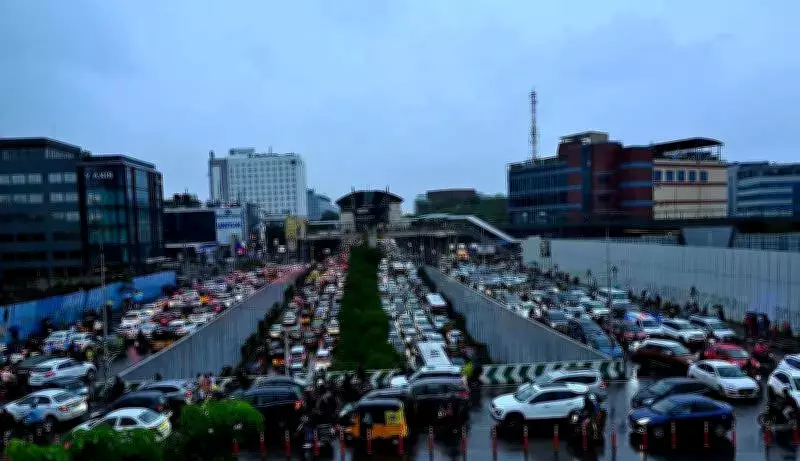
Hyderabad Traffic Crisis Intensifies as Average Speeds Plummet
Hyderabad is rapidly descending into a traffic nightmare reminiscent of Bengaluru, with recent data revealing a sharp decline in average vehicle speeds. In less than a year, the city's average traffic speed has dropped from 25 kmph to a concerning 18.4 kmph, placing it behind other major metros like Mumbai and Delhi, which record speeds of 20.8 kmph and 25 kmph respectively. Bengaluru, India's most congested metro, is only marginally worse at 16.6 kmph, highlighting Hyderabad's escalating crisis.
Explosive Vehicle Growth Overwhelms Road Infrastructure
The primary driver of this congestion is the explosive growth in vehicle population, which has mirrored Bengaluru's pace in recent years. Between 2021 and 2024, Hyderabad registered nearly 18 lakh personal vehicles, including two-wheelers and cars, almost matching Bengaluru's 19 lakh additions during the same period. This surge has overwhelmed the city's 900-km primary road network, which now carries more than 88 lakh vehicles, making daily commutes increasingly nightmarish.
If current trends persist, Hyderabad is projected to cross the one-crore vehicle mark by 2027–28. Moreover, the city boasts one of the highest vehicle densities in the country, with nearly 9,500 vehicles per km on major roads—a significant increase from about 6,500 per km in 2019. While the road network has largely remained unchanged, traffic load in Greater Hyderabad has doubled over the last decade, with registered vehicles jumping from around 45 lakh in 2016 to nearly 88 lakh by the end of 2025.

Daily Additions and Parking Space Crisis
The relentless pace of growth sees at least 1,500 new vehicles added to Hyderabad's roads every day. Annual registrations have climbed steadily from 3.7 lakh in 2021 to nearly 5 lakh in 2025, with over 15 lakh new vehicles entering the city in the last four years alone. Four-wheelers, in particular, have increased rapidly from 9.2 lakh in 2017 to 17.6 lakh in 2025.
According to RTA officials, increasing dependence on private vehicles has compounded the problem. K Ilambarithi, commissioner of the Telangana Transport department, noted that nearly 35% of road space is occupied by two-wheelers and four-wheelers on an average day, rising to 45% during peak hours. He warned that the city would require around 200 acres of additional parking space annually just to accommodate new vehicles, emphasizing the urgent need for policy measures like promoting public transport, car-pooling, and dedicated lanes for high-occupancy vehicles.
Commuters Bear the Brunt: Survey Highlights Time Loss
A recent survey by TomTom, a Netherlands-based location and navigation technology firm, underscores the severe impact of traffic congestion on Hyderabad's residents. The study reveals that every motorist in Hyderabad spends over five days a year stuck in traffic jams, totaling around 123 hours annually. Travel time averages 32.3 minutes to cover a 10-km stretch, with speeds dropping further to 16.1 kmph during evening peak hours. These findings place Hyderabad among the top 10 'mega-slow' cities globally, surpassing metros like New York, London, and Tokyo.
Expert Insights and Call for Action
Experts attribute the crisis to multiple factors, including poor road design, weak enforcement, lack of public transport integration, and unplanned urbanisation. Bandhan Bandhu Majumdar, associate professor at the Transportation Research Innovation Analysis Laboratory, BITS Pilani Hyderabad, stated that effective transportation demand management strategies are crucial. He suggested congestion pricing during peak hours, improvements in sidewalk and crosswalk infrastructure, and efficient city-wide parking management systems to alleviate conditions.
TS Reddy, a retired official from the Central Road Research Institute, warned that Hyderabad's traffic problem reflects policy failure and flawed urban form, with the city expanding horizontally without proportionate investment in public transit or last-mile connectivity. Urban planners caution that without government intervention, the crisis will worsen, leading to increased commute times, fuel consumption, and air pollution, adversely impacting residents' quality of life.






