

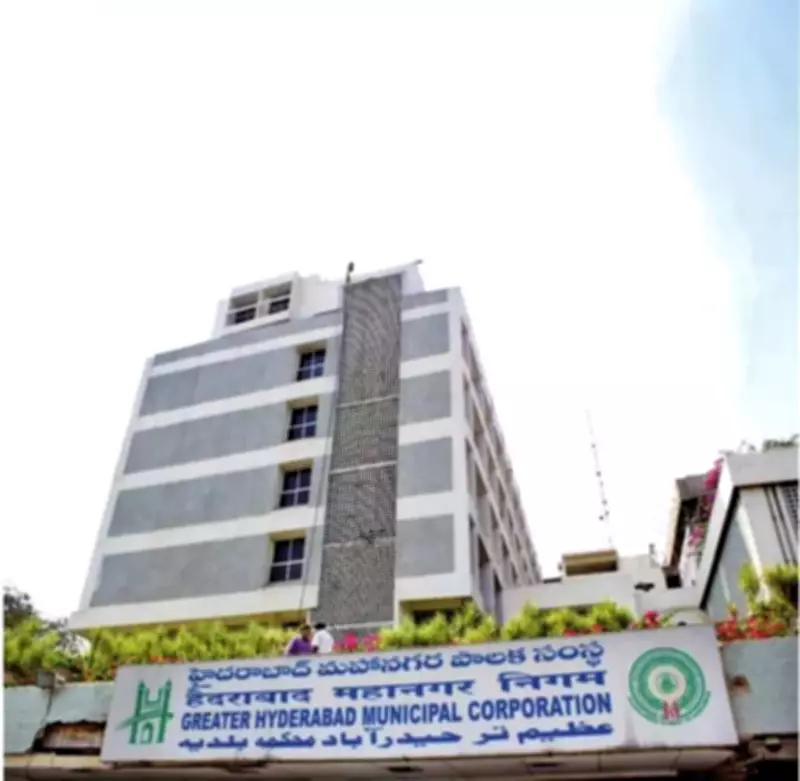
Telangana Government Announces Trifurcation of Hyderabad's Municipal Administration
In a significant administrative shake-up, the Telangana government delivered a major announcement on Wednesday, splitting the Greater Hyderabad Municipal Corporation (GHMC) into three distinct municipal corporations. This restructuring creates the Cyberabad Municipal Corporation (CMC) and the Malkajgiri Municipal Corporation (MMC), alongside the existing GHMC, marking the most substantial reorganization of Hyderabad's civic body since 2007.
Appointments and Jurisdictional Changes
The government has appointed senior IAS officers to lead the new corporations, with G Srijana taking charge as commissioner of CMC and T Vinay Krishna Reddy appointed as commissioner of MMC. R V Karnan has been retained as the commissioner of GHMC. This move comes just months after a mega expansion of GHMC limits, which had doubled its wards from 150 to 300 by merging 27 surrounding urban local bodies, positioning Hyderabad as India's largest municipal corporation.
With the trifurcation, GHMC's jurisdiction reverts to 150 wards, while CMC will comprise 76 wards and MMC will have 74 wards. This new structure aligns with major metropolitan cities like Mumbai and Bengaluru, which operate through multiple civic bodies, aiming to decentralize governance and enhance administrative efficiency in the rapidly growing urban zones.

Political and Administrative Implications
While civic officials assert that the reorganization is designed to improve governance and align with the city's three police commissionerates, sources indicate political motivations behind the move. It is reported that ruling party MLAs had expressed concerns over losing authority in a consolidated corporation, influencing the decision. Additionally, the AIMIM party had objected to the earlier merger plan, adding to the political dynamics.
To oversee the transition, the government has entrusted Jayesh Ranjan, chief secretary for metropolitan area and urban development, with the additional role of special officer for all three corporations. With the term of GHMC's elected body ending on February 10, Ranjan will supervise governance across all 300 wards until municipal elections are held later this year.
Operational Details and Future Framework
Under the new arrangement, GHMC will continue to operate from its headquarters at Lower Tank Bund. CMC will function from a newly established office in the National Academy of Construction building at Hi-Tec City, and MMC will be housed at the former Hyderabad Metropolitan Development Authority office in Tarnaka.
A senior GHMC official stated, "The restructuring is intended to create a more citizen-centric and future-ready urban governance framework for the Hyderabad metropolitan region, which now caters to an estimated 1.3 crore people living within the Telangana Core Urban Region (TCUR)."
Geographical Distribution and Zonal Breakdown
The trifurcation divides Hyderabad into specific zones for each corporation:
- GHMC: Covers Secunderabad, Charminar, Khairatabad, Rajendranagar, Golconda, and Shamshabad, with a total area of 689 square kilometers.
- CMC: Includes Serilingampally, Kukatpally, and Quthbullapur, spanning approximately 680 square kilometers.
- MMC: Encompasses Malkajgiri, Uppal, and LB Nagar, covering around 685 square kilometers.
The corporations are further organized into zones, circles, and wards as follows:
- GHMC: 6 zones, 30 circles, 150 wards.
- CMC: 3 zones, 16 circles, 76 wards.
- MMC: 3 zones, 14 circles, 74 wards.
This comprehensive restructuring aims to streamline municipal operations and address the challenges of urban expansion in one of India's fastest-growing metropolitan areas.






