

IEWG Proposes New Data-Driven Framework for Social Justice Delivery
In a significant development, the Independent Expert Working Group (IEWG) on the caste survey has proposed a paradigm shift in how social justice resources are delivered to marginalized communities. During a press conference in Hyderabad on Wednesday, the group outlined a vision where instead of the government attempting to fill what they termed the 'social justice well' with resources for all groups, a new framework could enable direct delivery to needy households through what they described as a 'social justice tap'.
From Broad Allocation to Targeted Delivery
The IEWG emphasized that while they are not formally mandated to provide specific recommendations based on the Caste Backwardness Index (CBI) score, they have developed an approach centered on targeted social policies that the government could implement. This represents a fundamental rethinking of how resources are allocated to address historical inequalities.
"The committee only examined and analysed the survey data provided by the government," stated IEWG convenor Pravin Chakravarty during the press conference. "Our job is not to provide recommendations; the government and experts can draw inferences from the detailed data we provided. However, we did mention in our report that a social justice framework could be considered."

Addressing the 'Bad Birth Lottery'
The IEWG report highlights what experts refer to as the 'bad birth lottery' - the systemic inequalities that arise from being born into certain caste groups. The report argues that effectively tackling these deep-rooted disparities requires implementing what they term Social Justice 2.0, characterized by precisely targeted social policies based on comprehensive data analysis.
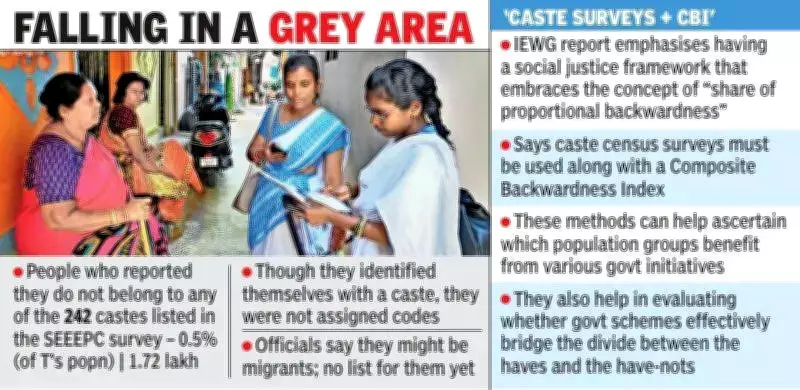
Central to this approach is the concept of 'share of proportional backwardness', which focuses resources on communities experiencing the most significant disadvantages regardless of their population size. This represents a departure from traditional approaches that often consider demographic weight in resource allocation decisions.
Data-Driven Classification for Effective Governance
The report emphasizes the critical importance of accurately identifying caste groups based on their genuine levels of backwardness, without consideration for population statistics. Such precise classification is essential, according to the IEWG, to establish a governance framework specifically dedicated to uplifting those castes that face the most substantial challenges and disadvantages.
The Group posits that outlining caste groups in a manner that reflects their true socio-economic conditions is essential for formulating effective empowerment strategies. This data-driven approach would help create targeted interventions for those most in need, potentially leading to more efficient resource utilization and more substantial impact on ground-level inequalities.
The proposed framework suggests moving beyond blanket policies to create customized solutions based on the specific backwardness indicators identified through the caste survey data. This could enable policymakers to design interventions that address the unique challenges faced by different communities, potentially creating a more just and equitable society through evidence-based governance approaches.






