India's Digital Governance Framework in the Age of Artificial Intelligence
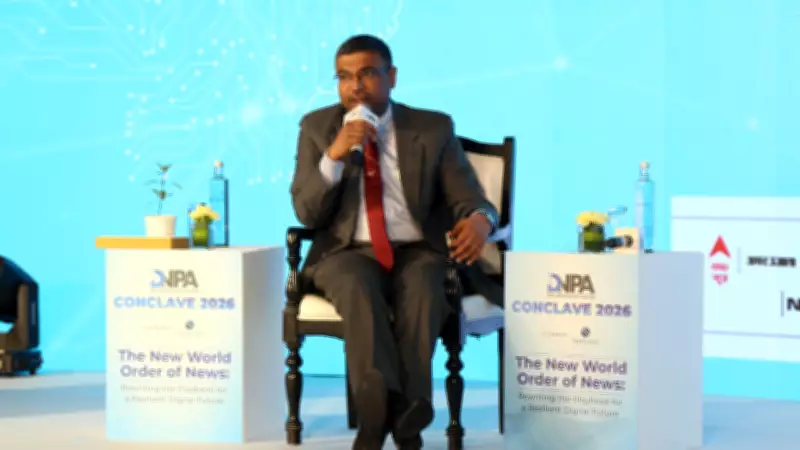
At the prestigious DNPA Conclave 2026, a significant gathering of policymakers and industry leaders convened to deliberate on the rapidly evolving digital ecosystem. The central theme revolved around the formidable challenges of governing communications in an era increasingly dominated by artificial intelligence.
Constitutional Boundaries and Platform Accountability
During a pivotal session titled 'The Regulatory Reset: Governing India's Digital Communications in the AI Era', S Krishnan, Secretary of the Ministry of Electronics and Information Technology (MeitY), provided a detailed exposition of India's strategy. He articulated the nation's endeavor to meticulously balance the fundamental right to free expression with the imperative of holding digital platforms accountable.
"Freedom of expression is subject to certain restrictions which are ingrained in Article 19(2) of the Constitution," Krishnan stated authoritatively. "Those grounds are very clear. So on those grounds there could be reasonable restrictions on freedom of speech. And the courts have repeatedly upheld that."

He firmly asserted that existing social media regulations do not overstep the constitutional mandate. Krishnan specifically highlighted Section 69A of the Information Technology Act as a cornerstone regulatory mechanism. This section directly addresses the types of restrictions permissible under Article 19(2), providing a legal basis for government action.
The Comprehensive Legal Framework
Krishnan elaborated that other constitutional grounds for restriction, such as content that is defamatory or obscene, are managed through separate legal provisions. However, he emphasized that these all form an integral part of a cohesive and wider regulatory framework designed to maintain order and protect citizens in the digital space.
"The government works strictly within the framework of the law," he reiterated. His message to global tech platforms was unambiguous: entities operating within Indian territory must respect and adhere to constitutionally valid restrictions. "If they want to operate in India, they should abide by Indian laws," he declared, underscoring the principle of national sovereignty in digital governance.
Addressing Societal Trends and Synthetic Content
When questioned about the viral nature of sensationalized content, Krishnan offered a sociological perspective. He suggested that the disproportionate reach of such material is a deeper reflection of societal preferences and behaviors, indicating a complex interplay between technology and human psychology.
Looking forward, he spotlighted a proactive government initiative: a new rule mandating the clear labelling of synthetically generated or AI-created content. This measure aims to foster transparency and ensure users are fully aware of the nature of the media they are consuming, a critical step in an age of deepfakes and advanced digital manipulation.
Firm Stance on Innovation and Regulation
In his concluding remarks, Krishnan's statements powerfully underscored the government's official position. While acknowledging that digital innovation and artificial intelligence are profoundly reshaping the landscape of global communication, he made it clear that regulatory oversight in India will continue to operate with unwavering commitment to its constitutional boundaries.
The conclave thus served as a definitive platform, clarifying India's intent to navigate the turbulent waters of the AI revolution with a steady hand on the legal tiller, ensuring that progress does not come at the cost of fundamental rights or social harmony.