

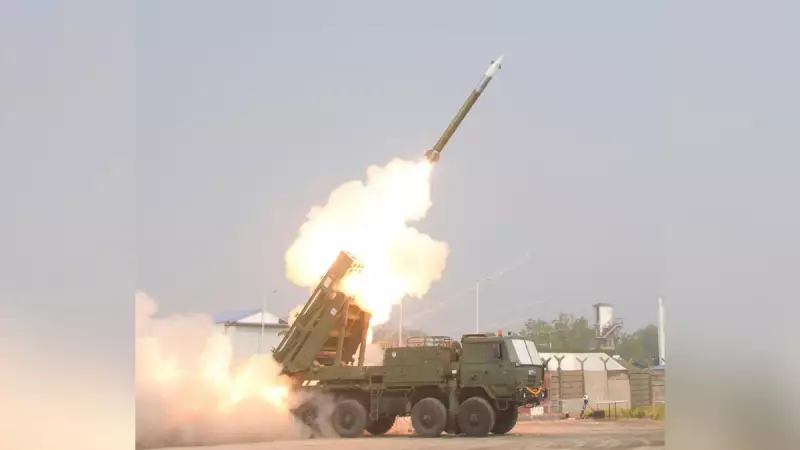
In a significant leap for India's indigenous defence capabilities, the Defence Research and Development Organisation (DRDO) has successfully conducted the maiden flight test of the Pinaka Long-Range Guided Rocket. The landmark test was carried out on December 29, 2024, from the Integrated Test Range (ITR) in Chandipur, off the coast of Odisha.
A Major Milestone in Rocket Artillery
The successful test represents a critical advancement in India's artillery firepower. The Pinaka system, already a mainstay of the Indian Army's regiments, has now been enhanced with a new, long-range, and precision-guided variant. This test validates the complete performance of the rocket system, including its advanced guidance and control mechanisms.
The rocket met all its mission objectives with a high degree of accuracy, striking a target at a significantly extended range. While the exact range was not disclosed in the official announcement, it is understood to be a substantial improvement over the existing Pinaka Mk-I and Mk-II systems, which have operational ranges of around 38 km and 45 km respectively. The development focuses on enhancing precision to minimise collateral damage and maximise operational effectiveness.

Boosting Indigenous Defence Manufacturing
This achievement is a testament to the growing prowess of India's defence research ecosystem. The Pinaka Long-Range Guided Rocket has been developed domestically by a consortium of DRDO laboratories in collaboration with Indian industry partners. Key contributors include the Armament Research & Development Establishment (ARDE) in Pune and the High Energy Materials Research Laboratory (HEMRL), also in Pune.
The development aligns perfectly with the national 'Aatmanirbhar Bharat' (Self-Reliant India) initiative in the defence sector. By mastering such complex technologies, India reduces its dependency on foreign imports for critical artillery systems, ensuring strategic autonomy and bolstering its defence preparedness along the borders.
Strategic Implications and Future Trajectory
The induction of a long-range, precision-guided Pinaka variant will provide the Indian Army with a formidable force multiplier. It will enable forces to engage enemy targets, including concentrations of troops, ammunition dumps, and command centres, with pinpoint accuracy from safe distances, thereby providing a critical tactical advantage.
The successful maiden test paves the way for more extensive user trials by the Indian Army. Following these trials, the system is expected to be cleared for bulk production and eventual induction into the artillery corps. This development also opens avenues for potential export to friendly nations, showcasing India's growing stature as a reliable defence technology provider.
Defence Minister Rajnath Singh congratulated the DRDO and associated teams on the successful test. He hailed it as a remarkable achievement that strengthens national security and exemplifies the nation's technological ingenuity. The test marks a proud moment for Indian defence scientists and engineers, reinforcing their capability to develop world-class weapon systems.






