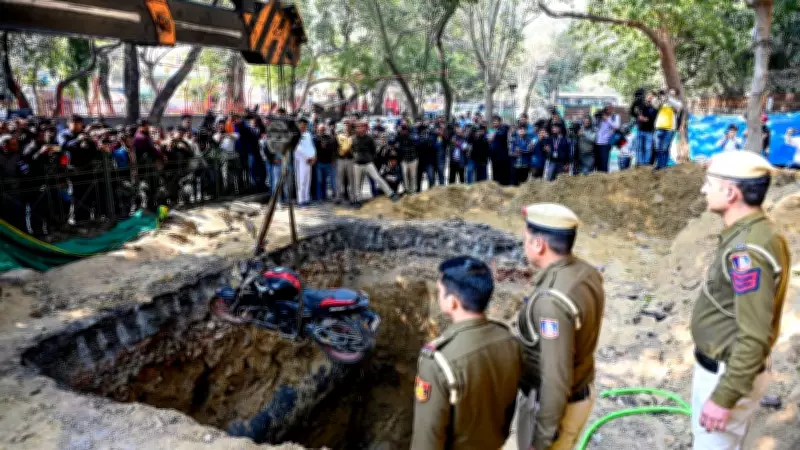
Janakpuri Biker's Tragic Death Reveals Critical Lapses in Delhi Jal Board Safety Protocols
A fatal incident in Janakpuri, where a biker fell to his death into an unbarricaded pit, has starkly exposed violations of the Delhi Jal Board's (DJB) established safety codes. Officials have confirmed that the accident underscores significant procedural failures, with a senior DJB official pointing out that contractors frequently neglect essential safety measures, such as proper barricading, to cut costs.
DJB's Detailed Safety Advisory and Its Evident Breach
In response to a rising number of accidents during sewer and pipeline works, the Delhi Jal Board issued a comprehensive safety advisory last year. This advisory mandates strict protocols, including proper barricading with red-and-white fluorescent sheets, warning signage, adequate lighting, and trench protection. It explicitly states that contractors should not receive payment unless the engineer in charge certifies compliance with these safety measures.
The advisory further specifies that diversion boards must be placed to channel traffic, easily readable warning signals installed ahead of work areas, and reflecting lights, caution boards, and diversion signage maintained daily. Additionally, it prohibits stacking excavated earth along trench edges to prevent collapses, requires removal of surplus debris on the same day, and mandates consolidation of filled-up earth in layers to avoid settlement.

Official Highlights Systemic Failures and Hazards
A senior official familiar with sewer rehabilitation works emphasized that the biker's death indicates a clear violation of these safety codes. "There are standard safety codes available with Delhi Jal Board where safety measures to be taken by contractors are clearly mentioned. The incident of the biker's death indicates that there has been a violation of the safety code at some point," the official stated.
The official elaborated on the inherent dangers of sewer works, noting risks such as flooding and harmful gas leaks. "There are chances of flooding. The portion of the pipeline being repaired is stopped, but if by any chance it is removed, there is a risk of death due to flooding. Secondly, the risk of leaking harmful gases is also there. In rehabilitation work, we often do desilting. There are trapped gases during sludge," the official explained.
Audit Mechanisms and Contractor Accountability
According to the official, every DJB division is required to maintain an accident register and adhere to National Human Rights Commission (NHRC) guidelines on workplace safety, alongside tender-level safety conditions. An internal audit mechanism is also mandated to review safety measures. However, the official criticized the lack of enforcement, stating, "What are the safety measures available internally? There has to be an audit of the safety measures internally with the employees. Secondly, if the project is ongoing, the concerned engineer should check and ensure barricading. It is common that contractors do not do barricading to save money."
The official stressed that safety obligations are non-negotiable, regardless of project scale. "For any such work, the Delhi Jal Board executive engineer has to give a certification that inspection has taken place and that safety measures are being followed, and he has to submit it," the official added, highlighting the need for stricter oversight to prevent such tragedies.