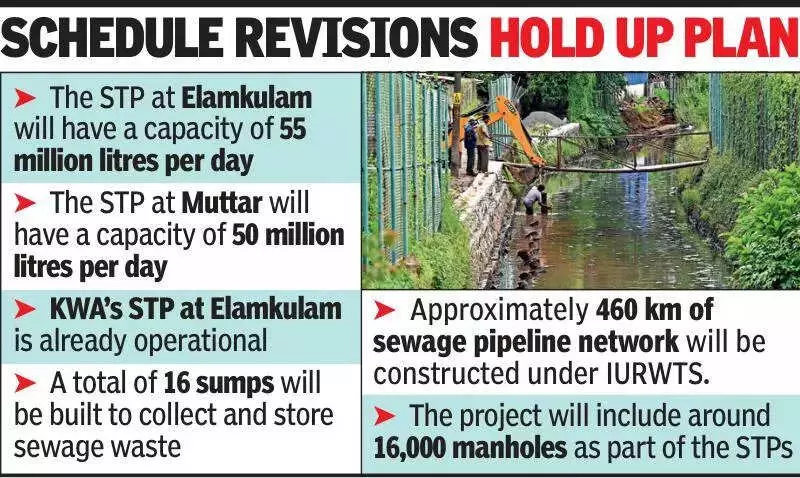
The ambitious plan to overhaul Kochi's sewage and water transport infrastructure has hit another major roadblock. The implementation of Sewage Treatment Plants (STPs) and their pipeline network under the Integrated Urban Regeneration and Water Transport System (IURWTS) project is facing significant delays due to a sharp escalation in project costs.
Sharp Cost Escalation Halts Tender Process
The estimated cost for establishing the STPs and the associated pipeline network has witnessed a staggering increase of Rs 400 crore. The budget has now been revised upwards from the original Rs 1,300 crore to Rs 1,700 crore. As a result, the Kerala Water Authority (KWA) cannot proceed with floating tenders for the work until the state government grants formal approval for this revised estimate.
Senior KWA officials overseeing the project have attributed this cost escalation to two primary factors. The revision in the project schedule is a key reason, as the original estimate was based on the 2018 schedule of rates. The estimate had to be updated when the 2021 schedule came into effect. Furthermore, officials confirmed a change in the materials specified for the pipeline network. The project will now utilize higher-quality and more durable pipes, which has contributed to the increased expenditure.

Project Structure and Current Status
The IURWTS project, primarily funded by the Kerala Infrastructure Investment Fund Board (KIIFB), has also seen a shift in its implementing agencies. Initially, Kochi Metro Rail Ltd (KMRL) was the sole agency in charge. The government later bifurcated the responsibilities. Now, KWA is tasked with implementing the sewerage component, which includes the STPs and pipelines, while KMRL handles the canal rejuvenation part of the grand plan.
Despite the delays and cost overruns, the project's core objective remains intact. Although the number of planned STPs has been reduced to two, their combined treatment capacity remains unchanged. The two plants will be constructed at Elamkulam and Muttar near Eloor. Land acquisition appears to be on track, with KWA owning the land at Elamkulam and KMRL having already acquired approximately three acres at the Muttar site.
Scope and Pending Challenges
Upon completion, these two STPs are designed to treat sewage from households across a vast area. They will cover most regions under the Kochi corporation, excluding Willingdon Island and West Kochi. The network will also extend to certain areas within the Kalamassery, Eloor, and Tripunithura municipalities.
However, the parallel canal rejuvenation component under KMRL's purview is yet to gain momentum. Crucial preliminary work by the revenue and survey departments is still pending. The survey department must first identify all encroachments along the canals slated for renovation. Following this, the revenue department is responsible for evicting these encroachments. Work on canal rejuvenation cannot begin until these foundational steps are completed, adding another layer of delay to the overall IURWTS project.
The revised estimate now sits with the state government for approval. The future pace of Kochi's critical urban regeneration and sewage management project hinges on this administrative green light, leaving citizens waiting for a cleaner, more efficient water infrastructure system.