

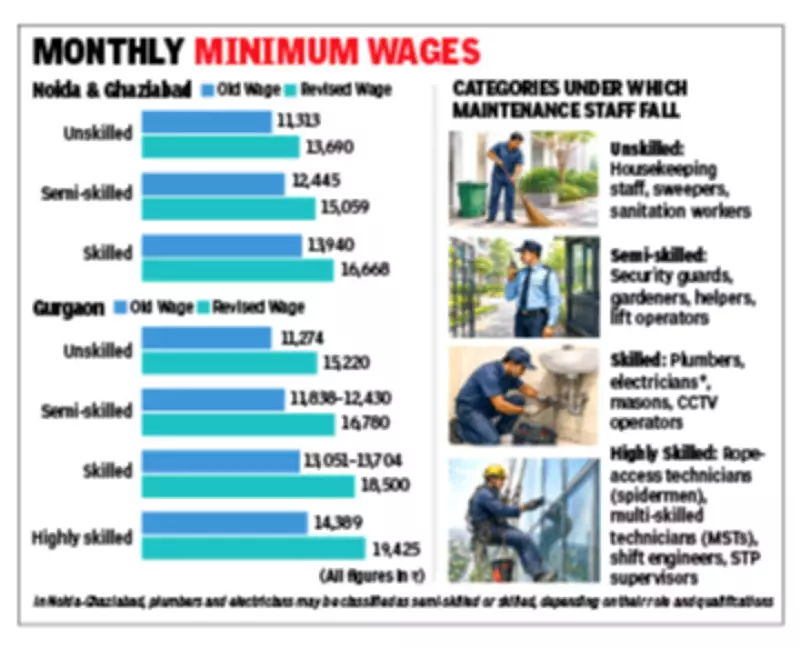
The newly implemented labour code has led to a significant increase in minimum wages, prompting residential societies across Noida, Ghaziabad, and Gurgaon to revise their maintenance charges. This move is expected to raise monthly bills by 20-30%, depending on the staff employed.
Impact on Maintenance Budgets
Manpower costs account for 70-85% of the maintenance budget in most societies, covering security guards, housekeeping, horticulture, electricians, plumbers, and lift operators. The wage revision is the single biggest cost escalation resident welfare associations (RWAs) and apartment owners associations (AOAs) have faced in years. Rising diesel prices for power backup have further squeezed budgets.
Societies Already Revising Charges
Several societies have already increased common area maintenance (CAM) charges. At Emaar Palm Gardens in Gurgaon, CAM charges rose from Rs 3.15 to Rs 4.37 per square foot after a general body meeting. Sunil Sharma, RWA president, said, "The revised wages increased our manpower costs by around 35%." For residents, this translates to an additional Rs 2,500-3,000 per month.

Prateek Wisteria in Noida's Sector 77 increased charges by 60 paise over the existing rate of Rs 2.7 per sq ft. In Ghaziabad, Orange County in Indirapuram circulated a note explaining that maintenance charges had remained unchanged for nearly 17 years. The note stated, "Compliance with revised statutory wages is not optional but a legal obligation." The society has not yet revised charges.
Skytech Magadh in Vaishali, where charges have been frozen at Rs 2 per sq ft since 2012, is considering a hike to Rs 3 per sq ft, subject to resident approval.
Cost-Cutting Measures
Some AOAs are exploring cost-cutting options. Kavita Kumar Rajesh, AOA president of Exotica Fresco in Noida's Sector 137, said, "While some upward revision is likely, our objective is to arrive at the most optimised and resident-friendly solution."
In Greater Noida West, Arihant Arden is commissioning a 500 KWp solar system to offset electricity costs. AOA president Nishith Chaturvedi explained, "The estimated additional monthly burden after the wage hike is approximately Rs 5.31 lakh. The solar panels are expected to help cut electricity costs."
Praveen Malik, RWA president of Gurgaon's Rising Homes, highlighted the cost burden: "A society with 700-800 flats could employ around 100 workers. If a security guard's salary increases by Rs 3,000 per month, a society with 50 guards faces an additional Rs 1.5 lakh monthly expense."
Residents Push Back
Not all residents accept the revised bills. At Supertech Eco Village 1, Greater Noida West, residents protested a proposed hike from Rs 2.36 to Rs 3.25 per sq ft. Ranjana Suri Bhardwaj said, "This marks a significant increase and imposes an undue financial burden." Similar protests occurred at Tata Eureka Park and Crest Villa.
At BPTP Astaire Gardens in Gurgaon, CAM charges nearly doubled over 18 months. Resident Debojit Hore said, "Maintenance agencies use the wage revision to justify increases across their entire cost structure." He also flagged the absence of GST input credit benefits being passed on to residents.
At Antriksh Golf View 2 in Noida, residents questioned the frequency of revisions. A proposal sought a 30 paise per sq ft increase in CAM charges and a revision in DG charges from Rs 16 to Rs 27 per unit, barely six months after the previous revision.
Broader Implications
Puneet Sharma, president of the Noida Federation of Apartment Owners Associations (NOFAA), described the situation as a "three-pronged hit: revised minimum wages, increased fuel costs, and the upcoming electricity rate hike in UP." NOFAA secretary general Surojit Dasgupta added that AOAs face rising compliance obligations around GST, income tax, labour laws, and safety regulations.
RWAs are seeking government relief, including a higher GST exemption threshold on maintenance charges, rebates for residential societies, or offsets through property tax. Sunil Sharma of Emaar Palm Gardens said, "The entire burden of the wage revision is ultimately falling on residents. There should be a mechanism to cushion them from a sudden spike."






