Lucknow's Stray Dog Sterilization Model Emerges as National Blueprint Amid Supreme Court Deliberations
As the Supreme Court of India actively explores effective and humane methods to manage the country's growing stray dog population, a compelling template for success is emerging from Uttar Pradesh. This development gains urgency alongside disturbing reports from Telangana regarding mass poisoning of street dogs, highlighting the critical need for scientific and compassionate approaches.
Lucknow's ABC Program: A Benchmark of Efficiency
During Supreme Court hearings, Lucknow, the capital of Uttar Pradesh, has been prominently cited as a leading example for operating one of the nation's most efficient Animal Birth Control (ABC) programs. The Lucknow Municipal Corporation has achieved a remarkable milestone by sterilizing approximately 85% of the estimated 1.35 lakh stray dogs within the city. This figure significantly surpasses the 70% sterilization threshold recommended by the World Health Organization (WHO), a target that many Indian metropolitan areas continue to struggle to reach.
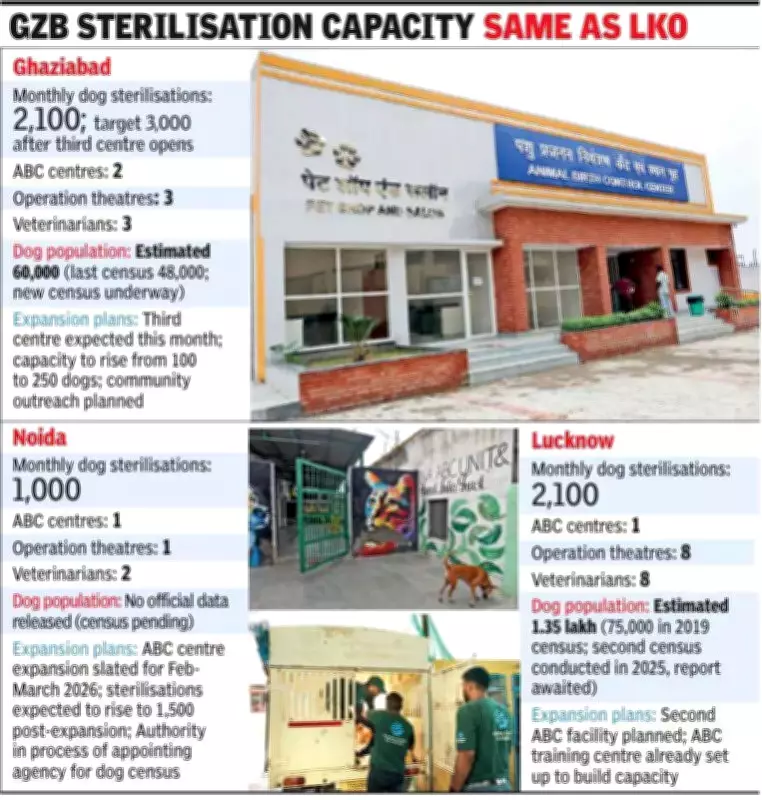
The foundation of Lucknow's success lies in a targeted approach initiated in 2019, following a comprehensive dog census that estimated the stray population at around 75,000. Abhinav Verma, the Animal Welfare Officer at Lucknow Municipal Corporation, detailed the operational model. The city's sole ABC center, established as a public-private partnership with the NGO Humane World for Animals India (HWAI), is equipped with eight operation theaters and staffed by eight veterinarians. This facility has a holding capacity for 300 dogs.

"While monthly sterilization numbers dipped during 2020 and 2021 due to Covid-19 restrictions, we have consistently sterilized 2,100 dogs per month since 2022. This sustained effort enabled us to achieve one lakh sterilizations by December 2025," Verma explained.
The Pillars of Success: Data, Consistency, and Community
Officials attribute Lucknow's achievements to three core pillars: rigorous data management, operational consistency, and deep community engagement. The program invested heavily in scientific assessment, conducting another detailed dog census in 2025 to accurately gauge progress. Furthermore, HWAI conducts a monitoring survey of the dog population every six months, using a scientific method to estimate the coverage of sterilized dogs per street kilometer and establish reliable baselines.
Perhaps the most transformative element has been community involvement. While many programs rely solely on animal feeders, Lucknow's initiative includes extensive awareness campaigns. Teams from HWAI and the municipal corporation engage with residents in neighborhoods, slum clusters, schools, and colleges. These programs educate the public on the ABC rules—which prohibit the relocation of stray dogs to prevent territorial aggression—and on understanding canine behavior to minimize human-animal conflict.
"Educating people about the program and regulations led to a significant increase in stray dogs being brought in for sterilization. This fostered greater community harmony and a better understanding of how to coexist with street dogs," Verma noted. Keren Nazareth, Senior Director at HWAI, reported that since 2019, their 'Abhay Sankalp' initiative has reached over 500 localities in Lucknow.
Replication Across Uttar Pradesh: Ghaziabad and Noida Follow Suit
Inspired by Lucknow's results, other cities in Uttar Pradesh are actively adopting this model. Ghaziabad has made substantial strides, now matching Lucknow's monthly sterilization rate of 2,100 dogs. With a third ABC center set to open, Ghaziabad's capacity will increase to 3,000 sterilizations per month, making it the only municipal corporation in UP to operate three such centers. The city's holding capacity will also rise to 250 dogs.
Anuj Singh, Deputy Chief Veterinary and Welfare Officer of Ghaziabad Municipal Corporation, expressed confidence: "With our current pace, we believe we can effectively control the stray dog population in Ghaziabad by next year." Since 2013, Ghaziabad has sterilized 45,000 dogs, with nearly half of that total accomplished since 2023. However, Singh acknowledged that a comprehensive dog census is still underway to accurately assess sterilization coverage against the estimated population of 60,000.

Noida is also progressing, though at a slower pace. Its lone ABC center currently sterilizes about 1,000 dogs monthly, with plans to expand capacity to 1,500 by March. The holding capacity will increase from 62 to 100 post-expansion. A significant challenge for Noida, as for Ghaziabad, is the lack of a recent dog census to scientifically measure program coverage. An official from Noida Authority stated they are in the process of finalizing an agency to conduct this crucial survey.
The Critical Gap: Community Engagement and Resources
Experts point out that a major differentiator for Lucknow is its intensive community engagement, an area where NCR cities currently lag. Piyush Patel, Director of HWAI, emphasized, "The Lucknow model is replicable because of its highly comprehensive approach. If these protocols are implemented, other cities can also control their stray dog populations."
Salman Syed from Friendicoes, the NGO partnering with Ghaziabad, noted that while infrastructure expansion has been the initial focus, community engagement programs are planned once the new centers are fully operational. Similarly, Dr. Devi from Animal India Trust, working in Noida, highlighted resource constraints: "For effective outreach, we need more people and more funds. With adequate support from authorities, we could achieve parity with Lucknow's coverage."
A State-Wide Initiative with National Implications
Building on Lucknow's success, the Uttar Pradesh government has launched a coordinated dog sterilization and management exercise across 17 municipal corporations in the state. From April to December 2025, approximately 1.2 lakh dogs were sterilized under this expanded initiative. Officials confirmed that Chief Minister Yogi Adityanath is closely monitoring these efforts to manage stray populations, including dogs and cattle.
As conflicts between animal lovers and other residents continue in densely populated urban areas, the Lucknow ABC program offers a proven, humane, and scientific framework. Its emphasis on data-driven strategy, consistent execution, and community partnership provides a viable blueprint not just for UP, but for cities across India grappling with the complex challenge of stray dog management.