

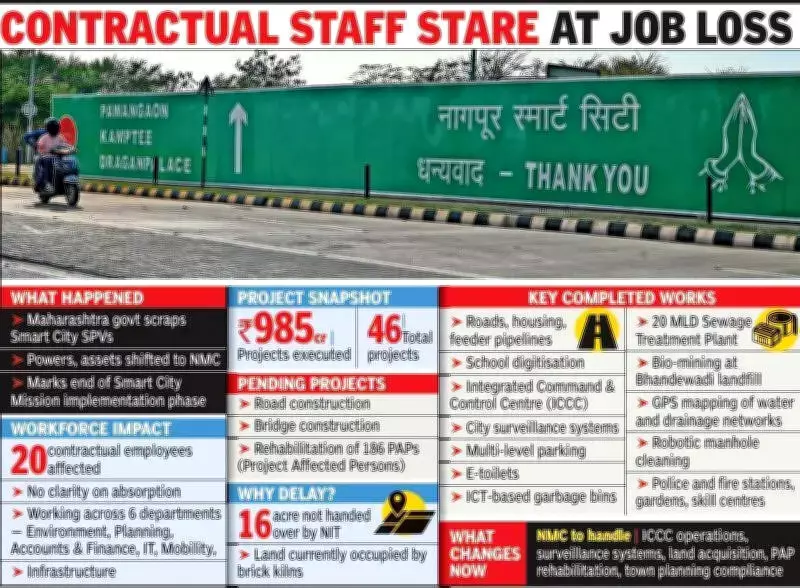
Nagpur: In a sweeping administrative overhaul marking the end of the Centre-backed Smart City Mission, the Maharashtra government has ordered the dismantling of special purpose vehicles (SPVs) across eight cities, including Nagpur, transferring all powers to municipal commissioners and effectively signalling the closure of the decade-long urban flagship programme.
Government Resolution Details
In a government resolution issued on April 21, the urban development department directed that chairpersons and board members of Smart City SPVs be relieved of their duties immediately. The respective municipal commissioners will also assume the role of chief executive officers (CEOs) of the SPVs.
The decision impacts key urban centres, including Nagpur, Pune, Nashik, Pimpri-Chinchwad, Thane, Kalyan-Dombivli, Solapur and Chhatrapati Sambhajinagar. In Nagpur, for instance, the powers held by MMRDA commissioner Sanjay Mukherjee as SPV chairman have been handed over to municipal commissioner Vipin Itankar.

Background and Transition Framework
The move comes in the backdrop of the Smart City Mission's official timeline ending, with no further financial support expected from the Centre. Despite an extended deadline to complete projects by December 2025, the state acknowledged that the mission period has lapsed, necessitating a transition framework for governance, assets and personnel. In a parallel directive, the government has ordered immediate transfer of all Smart City assets to the respective municipal corporations. Civic bodies have been asked to submit a compliance report by April 30.
Crucially, all contractual staff working under Smart City SPVs will be relieved, with their responsibilities redistributed among existing municipal staff — a move that could trigger concerns over job losses and administrative burden on already stretched civic systems.
Winding Up of SPVs
The GR also mandates that, once asset transfers are completed, the SPV companies — incorporated under the Companies Act specifically for the mission — must be formally wound up by their CEOs. The state government has asserted its overriding authority over SPVs, reiterating that all directives issued by the Centre and state shall remain binding, regardless of provisions in the companies' Articles of Association.
The decision marks a definitive shift away from the SPV-led model that was designed to bypass bureaucratic delays and fast-track urban projects. With their dissolution, the responsibility for sustaining and operating Smart City infrastructure now rests squarely with municipal corporations — raising questions about capacity, continuity and long-term urban governance.






