Why Indians Queue in Metro But Push in Buses: Economic Survey's 5 Key Reasons
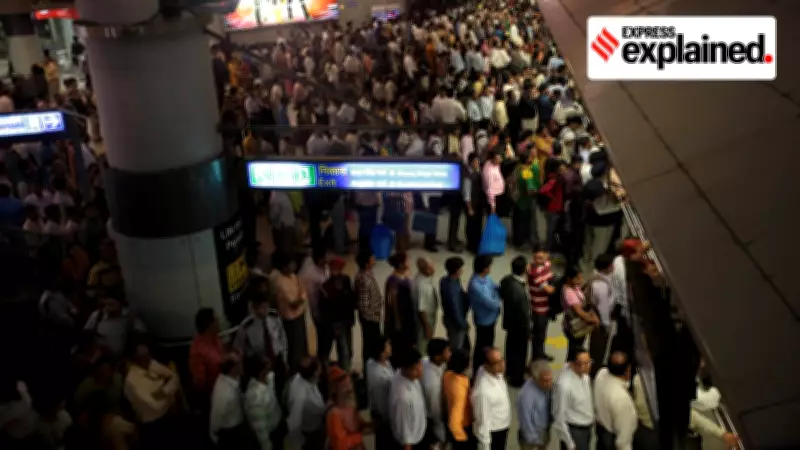
The Economic Survey 2025-26 has provided fascinating insights into a common behavioral paradox observed across India's public transport landscape. Why do Indian commuters patiently form orderly queues at Metro stations, Mumbai BEST services, airport check-ins, and passport offices, yet frequently push, grab seats, and jump lines when boarding buses and regular trains? The Survey identifies five crucial factors that explain this "common" yet puzzling behavior pattern.
The Cooperation Principle: When Systems Work With People
The Survey establishes a fundamental principle: a public transport system becomes orderly when it cooperates with people in a rational, visible, and dignified manner. This cooperation manifests through multiple channels that collectively encourage disciplined behavior rather than assuming it as a given cultural trait.
Five Factors That Create Orderly Behavior
- Clear Design Reducing Ambiguity: The system must be clearly designed to eliminate confusion about "right behavior." Metro systems feature proper entry and exit lines, barriers, turnstiles, marked queues, platform doors, and painted bays. "When the environment signals order, people usually follow it; when space is ambiguous, they improvise, and improvisation in crowded settings often looks like chaos," the Survey observes.
- Fair and Consistent Enforcement: Commuters expect rule enforcement, even if light-touch. Metro systems maintain staff presence, fines, and surveillance creating a "shadow of authority." Crucially, this enforcement is consistent and impersonal, unlike many other public settings where it's uneven or negotiable. "Where rules feel fair and predictable, compliance becomes easier to internalise," the Survey notes.
- Service Reliability and Predictability: When trains arrive at regular intervals with minimal waiting time (often just 1-2 minutes), pushing and line-jumping become unnecessary. However, when passengers face continuous delays, irregular services, and unpredictable traffic, they become opportunistic, losing trust that patience will be rewarded fairly by the system.
- Social Learning in Stable Systems: People learn from others in stable environments. Fellow passengers in Metro systems often object to unruly behavior, creating social pressure. "Once people see that others queue, give space, or avoid blocking doors, conformity starts to move toward order rather than disorder. The Metro's 'inside behaviour' becomes a social script; deviation attracts disapproval not only from authorities but from fellow passengers," the Survey explains.
- Dignified Public Spaces Worth Preserving: The Economic Survey emphasizes creating dignified public spaces that people value. When spaces are dilapidated, poorly maintained, or captured by vested interests, people feel no obligation to care for them. "The Metro has come to symbolise modernity, efficiency, and civic pride; users perceive it as a valued asset rather than a neglected public utility," it states, noting that neglect breeds further neglect.
Beyond "Cultural Deficiency" Explanations
The Survey makes an important observation that challenges simplistic cultural explanations. These orderly spaces are not merely "middle-class islands" of good behavior. Rather, when key system elements are absent—clear design, fair enforcement, reliability, social learning opportunities, and dignified maintenance—people naturally behave in disordered ways. This disorder then gets incorrectly labeled as "cultural deficiency" rather than recognized as a rational response to poorly designed systems.

The implications extend beyond transportation. The Economic Survey's framework suggests that any public commons—from parks to government offices to community facilities—can achieve orderly behavior through similar principles of system cooperation with people. The contrast between Metro discipline and bus chaos isn't about different types of Indians but about different quality systems they encounter daily.