

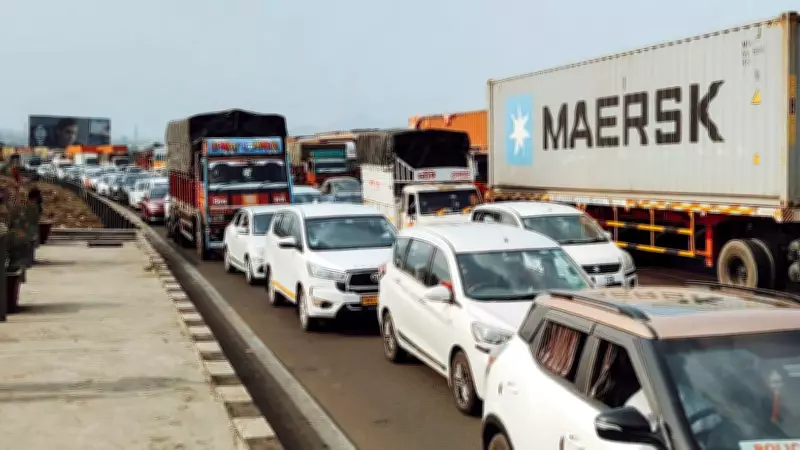
MSRDC Crafts Emergency Response Plan After Mumbai-Pune Expressway Chaos
In the wake of a severe one-and-a-half-day traffic standstill on the Mumbai-Pune Expressway, the Maharashtra State Road Development Corporation (MSRDC) has initiated work on a specialized emergency traffic plan. This move aims to enhance crisis management capabilities for future incidents, particularly until the long-term Missing Link project becomes operational.
Gridlock Triggered by Gas Tanker Accident
The massive disruption began on Tuesday around 5 pm when a tanker transporting highly flammable propylene gas overturned near the Adoshi tunnel in Raigad. The accident caused significant leakage, compelling authorities to immediately shut down the Mumbai-bound carriageway and implement traffic diversions. Acting on directives from Deputy Chief Minister Eknath Shinde, MSRDC officials are now meticulously analyzing the incident's progression to identify and rectify gaps in emergency response protocols.
MSRDC Managing Director Anil Kumar Gaikwad emphasized the unprecedented nature of the event, stating, "Such an incident has not happened before. While our emergency response plan activated quick response vehicles, ambulances, and firefighting units promptly, the grave safety concerns limited our immediate options."

Challenges in Containing the Crisis
The overturned tanker suffered damage to three valves, leading to a continuous propylene gas leak. With approximately 21 metric tonnes of this highly flammable substance on board, authorities mandated a safety radius of at least 15 metres to prevent potential explosions, necessitating the complete closure of Mumbai-bound lanes. Traffic was rerouted onto a single lane of the Pune-bound carriageway, while two lanes remained open for Pune-bound vehicles. Additional diversions were directed to the four-lane Old Mumbai Pune Highway.
This diversion strategy effectively compressed traffic from ten lanes—six on the Expressway and four on the old highway—into just seven lanes. The influx of heavy vehicles resulted in extensive congestion that persisted for over a day. An MSRDC official highlighted the complexity of stopping the gas leak, noting, "Securing chemical and mechanical experts to address the leak promptly and ensuring their timely arrival posed significant challenges. For non-hazardous cargo incidents, we can typically upright a tanker within an hour, but this situation was far more complex."
Resolution and Restoration Efforts
Although chemical experts and the National Disaster Response Force reached the site on Tuesday night, the entire day on Wednesday was required to safely transfer the flammable gas into other tankers. The overturned vehicle was finally towed away by 1 am on Thursday, allowing traffic to resume on the Mumbai-bound carriageway. Normal traffic flow was fully restored only by Thursday noon.
Long-Term Solution: The Missing Link Project
MSRDC officials underscored that while the emergency plan offers immediate improvements, the permanent resolution lies in the Missing Link project. Scheduled to become operational on May 1, this 13.3-km project will bypass the 19.8 km accident-prone ghat section between Khandala and Lonavala. By connecting Kusgaon and Khopoli through two tunnels measuring 1.64 km and 8.9 km, along with cable-stayed bridges, the route is expected to reduce travel time between Mumbai and Pune by approximately 30 minutes. Notably, vehicles carrying hazardous chemicals will be prohibited from using this stretch.
Gaikwad added, "There is always scope for improvement, which we will incorporate into our contingency plan. However, the Missing Link is the definitive solution to prevent traffic jams of this magnitude in the future." He also mentioned that police would investigate potential action against the tanker operator, emphasizing the transporter's responsibility for the safe movement of hazardous materials.






