

Mumbai Metro Network Achieves Major Milestone, Surpasses 100-Km Operational Length
In a significant development for urban transportation, the Mumbai Metropolitan Region's operational metro network has officially crossed the 100-kilometer milestone. This achievement, confirmed on Tuesday, propels Mumbai past Bengaluru's 96-km system to secure the position of India's second-largest metro network, trailing only the extensive Delhi NCR network.
Historic Inaugurations Mark Expansion into New Territories
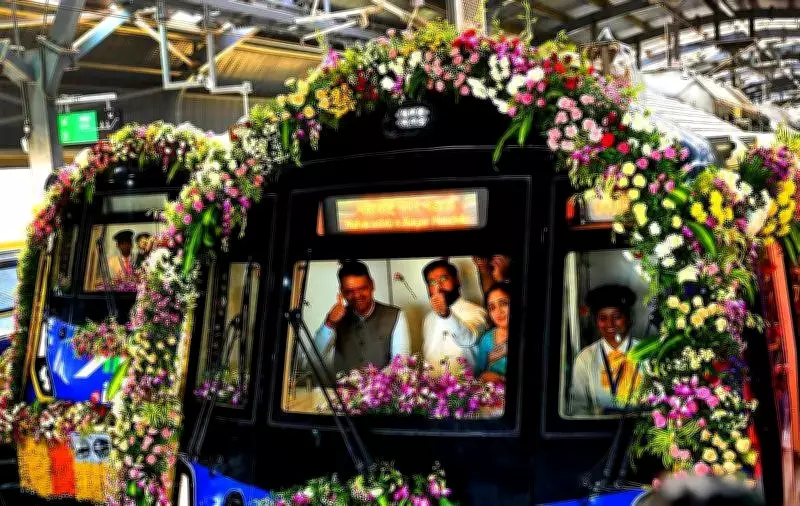
The milestone was celebrated with the inauguration of two critical metro stretches. Chief Minister Devendra Fadnavis, alongside deputy chief ministers Eknath Shinde and Sunetra Pawar, formally opened Phase I of Metro Line 9, connecting Dahisar to Kashigaon, and the inaugural section of Metro Line 2B, running from Mandale to Diamond Garden. Both new corridors will become accessible to the public starting Wednesday, April 8.
Metro Line 9's 4.4-km Phase I represents a historic first for Thane district, formally integrating the Mira-Bhayander area into Mumbai's metro framework. Concurrently, the initial segment of Metro Line 2B marks the metro's debut in Mumbai's eastern suburbs and harbour belt, promising to dramatically enhance connectivity in these previously underserved regions.

Strategic Integration and Future Growth Trajectory
With the addition of these new lines and the existing 10-km Navi Mumbai Metro corridor developed by Cidco, the total operational metro length within the Mumbai Metropolitan Region now stands at over 101 km. This positions MMR well ahead of Kolkata's 74-km network, though Delhi-NCR maintains a substantial lead with approximately 416 km of metro lines and 303 stations.
Chief Minister Fadnavis highlighted the accelerated pace of metro development, noting that several ongoing projects have reached 80-96% completion. He projected rapid network expansion in the coming years, with the full 337-km planned metro system poised to establish MMR as one of the world's longest operational metro networks upon commissioning.
Operational Reconfiguration and Enhanced Commuter Experience
The metro expansion has necessitated a major operational overhaul on the western corridor. Metro Line 7 has been integrated with the new Line 9 to provide direct connectivity from Gundavali to Dahisar and onward to Kashigaon. Meanwhile, Metro Line 2A will operate as a standalone service between Andheri West and Dahisar East.
Commuters traveling from Andheri West towards Gundavali or Kashigaon will now need to interchange at Dahisar station, though authorities assure that the transfer will remain within the paid concourse area for passenger convenience.
Substantial Investment and Phased Implementation
The Rs 6,500-crore Metro Line 9 project is being executed in two distinct phases. The recently inaugurated Phase I comprises four stations along its 4.4-km route. Phase II, spanning 4.3 km from Sai Baba Nagar to Subhash Chandra Bose Nagar with four additional stations, is being fast-tracked for commissioning later this year.
On the eastern front, the Mandale–Diamond Garden section of Line 2B is expected to significantly strengthen east Mumbai's transportation infrastructure. Looking ahead, the subsequent 6-km stretch between DN Nagar and Saraswati Colony in Khar, followed by an 11-km extension from Saraswati Colony to Chembur, is anticipated to become operational by 2027-28.
Vision for a Comprehensive Public Transport Ecosystem
Chief Minister Fadnavis emphasized Mumbai's commitment to building an accessible, convenient, and seamless public transport network. This vision includes planned integration of feeder buses and last-mile connectivity solutions around metro stations to ensure comprehensive mobility.
Deputy Chief Minister Shinde outlined the strategic importance of future integrations. Once Phase II of Line 9 reaches Subhash Chandra Bose Nagar, the corridor will seamlessly connect with Metro Lines 7 and 7A for direct airport access. Future interchanges with Metro Line 3 will enable uninterrupted travel to Colaba, while the proposed Wadala–Gaimukh corridor promises to extend connectivity to Bhayandar, further broadening suburban mobility options across the metropolitan region.






